Monday, July 6, 2015
Hatevil Nutter
We have written previously of the unique names adopted by the Congregational Societies. The Congregationalist were very open about their religious convictions.To join a Congregational Society a candidate was require to make a public "Proclamation of Faith". Another way they demonstrated that openness was in their selection of names. Hatevil is a contraction of Hate Evil. Hatevil Nutter was a strict Congregationalist who lived in Dover, New Hampshire. As a sign of the intolerance that the Congregationalists had for everything non Congregational, Hatevil led the cruel suppression of the first Quakers to appear in Dover.The suppression included stripping women of their cloths before tying them to a wagon wheel to be severely beaten. By the time his grandchildren were living in Dover the Society of Friends made up a substantial portion of the Dover community and played a major role in community affairs.


Quaker marriage document
The Society of Friends, the Quakers, kept the most detailed marriage records of any religious group in early America. The following is found in Volume-1 of the “Friends Society Marriage Records” in Dover, New Hampshire. The title page contains the notation March 1701. Within the Quaker community the church rules called for a young couple to publicly declare their intentions to marry in several public places over several months time. After such a declaration the Society would investigate the young couple to make sure they were “clear of all others” and sufficiently worthy by Church standards to marry. Once given the approval of the Society a marriage ceremony was held the essence of which was the signing of the marriage certificate.
“Whereas Henry Estes son of Benjamin and Elizabeth Estes of Barwick in the county of York in the Provence of the Massachusetts Bay in Newengland: and Mary Varney daughter of John and Sarah of Dover in ye Province of Newhampshire in Newengland aforesd, having declared their intentions of Taking Each other in marriage before several Publickmeetings of the People called Quakers in Dover aforesd according to the good order used amongst them whose Proceedings therein after a deliberate consideration thereof with a Regard to the Righteous Law of God and the Example of his People Recorded in the scriptures of Truth in that case were approved of by the sd meeting they appearing clear of all others and having consent of Parents and Relations concerned—Now these are to certifie all whom it may concern that for the full accomplishing of the sd intentions this seventeenth day of ye second month called April in ye year according to ye English account one thousand seven hundred and forty five---They ye sd Henry Estes and Mary Varney appearing in Publick assembley of ye aforesd People met together in the Publick meeting Place at Cochecha in Dover aforesd---And in a solemn manner he ye sd Henry Estes Taking ye sd Mary Varney by the hand did openly declear that he Took her to be his wife Promising by ye Lords assistance to be unto her True and Loving husband until death makes a separation.
And ye sd Mary Varney did then and there in Like solemn manner declear that she Took him ye sd Henry Estes to be her husband Promising by ye Lords assistance to be True and Loving wife until death makes a separation.
And ye sd Henry Estes and Mary Varney as a further confirmation hereof did then and there to these Presents sett their hand , she the sd Mary Varney assuming ye name of her husband, and we whose names are hereunto subscribed being Present amongst others at ye solleminizing of the sd marriage and subscription in manner as aforesd as witness hereunto have also to theses presents subscribe our names ye day and year above written.
Henry Estes, Mary Estes, Silvanus Hussey, Stephen Varney Jr. Ebenezer Varney, Timothy Emerson, Joseph Estes, Ephraim Tibbets Jr. Stephen Varney, William Frost ………..
Entered ye 22 of ye 2mo 1745
P William Fry Jr. Clerk”
Monday, June 29, 2015
Polly Needham wife of James Griffin of Killingworth, Connecticut
James Griffin’s birth is part of a family record found in the Land Registry in Killingworth. It says, ‘James, son of Samuel & Mary b. April 7, 1733.” James married Polly Needham February 24, 1757. The couple had three children, James, Allen and Polly. James and Polly are buried in the Indian River Cemetery in Clinton. The existing cemetery transcripts list them both as dying August 17, 1774 at the age of 36. However evidence suggests that, that date is for Polly as is shown on her headstone. Census records show James still living in 1790.


Tuesday, June 9, 2015
Asel Griffin and family
These photographs come to us from Tom Griffin with an assist from Ken Griffin. They are of Asel and his wife Ellen and their twins Etta and Ezra. Note the family resemblance among the various Griffin faces we have posted. Asel / Sylvester / Asahel / Samuel / Samuel Griffin of Killingworth.


Monday, June 8, 2015
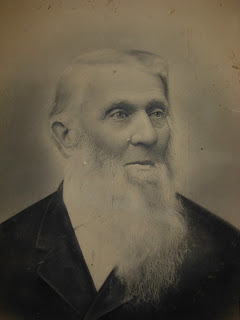
Albert Bailey Griffin 1809-1896
The following photograph comes to us courtesy of Michael Davis one of Albert's great grandsons. Albert was born in Essex, Vermont in 1809 and died in Kanarraville, Utah in 1896.His family line is Albert / Samuel / Samuel / Samuel Griffin of Killingworth. Note the family resemblance between Albert and and his great uncle Aashel Griffin.

Wednesday, January 21, 2015
The face of Asahel Griffin
Asahel Griffin was born in Killingworth, Connecticut the son of Samuel Griffin and his second wife Mercy Nettleton. There are a number of spellings used by his extend family. His birth record found in the ledgers of the Killingworth Second Congregational Society spells the name Asahel. In his father's will, published in Essex, Vermont, the name is spelled, Asahel. It was not uncommon in the era to see different spellings used for many names. The portrait that we present here comes to us courtesy of Ken Griffin a great grandson.Ken commissioned an artist by the name of Jacklynn Kelsey to produce this likeness using on old family photograph as a model.The remarkable thing about this image is how many of his features are shared by any number of Griffins scattered down the many family lines.

Tuesday, December 16, 2014
The Griffin Loom
Reference to a loom is woven throughout the family story of Samuel Griffin, 1739-1808. It was part of the family life in Killingworth and was transported to Essex when the family made what was at the time a very arduous journey to a new homestead. It occupies a prominent place in Samuel’s will. There were many tasks that need to be performed to produce the thread that was used in the weaving process. Previously on the Blog we have described the steps that transformed flax into linen thread. The most widely used material was wool. Sheep were very much a part of the farm life in Essex. In my family that tradition of keeping sheep was continued unbroken down to my father. In both Killingworth and in Essex the production of a finished piece of cloth was the sum of a number of smaller tasks. The girls Lois, Polly and Azuba, the boys Joel, Asahel, Worden, Samuel, John, and Dan were all certainly part of the cottage industry of weaving cloth. In the inventories in the wills found in New England records we very often find listed yards of cloth. Cloth was a cash crop for many early American families. While the whole family was involved in preparing the yarn and thread for weaving there was usually only one person who was the weaver. It is my reading of the Griffin family history that the weaver was Samuel a position he passed on to his son John. After all of the preparatory steps were finished the product that came off from the spinning wheel was high quality yarn. This yarn was used much as it is today for knitted items. By adding another attachment, a quill, to the spinning wheel the yarn was spun into the tread that was used to weave cloth. The quill spun the yarn into thread and the resulting thread ended up wound around the quill. In this manner the quill also served in the same role as a bobbin.-------The material that follows was written in Essex by the Castle family
On the front of the loom is placed the seat for the weaver, with the bobbin basket at the right to refill the shuttle. To put this loom in motion grandmother (or Samuel Griffin) takes the weaver’s seat, placing her feet on the treadles, in her right hand holding the shuttle, and with the left hand placed on the swing beam that holds the reed. The treadles being attached to the harness, the right foot presses the treadles down; this springs the harness that opens the warp and the shuttle is thrown form the right hand through the warp to the left hand, receiving the shuttle, while in turn the right hand is placed on the swing beam to bring the thread of filling to the proper place that the shuttle left in passing through the warp from the right to the left; the left food then presses the left treadle down, springing the harness attached to the treadles, the first treadle returning to its former place. The left hand then returns the shuttle to the right hand, the left hand on the beam brings the thread to its proper place. Thus grandmother’s feet transmits the power which opens the threads of the warp to receive the shuttle that holds the yarn bobbin for the filling of the warp; her hands swing the beam or lathe that receives and holds the reed that places the filling in its proper place in the warp. ------------- The spooling of the yarn for the shuttle with the old quill wheel and swifts was the work for the grandchildren. The writer has often remained at the old quill wheel and swifts spooling for the loom when the boys of the neighborhood were within hearing having a good time at play. But I had to keep the old thing buzzing until the bobbins were all filled for the shuttle, then grandmother would say: “You are a good boy. I will bake you a nice turnover pie the next time I bake.” And she always remembered her promise. ---------------- Homespun Cloth. The, all wool goods a yard wide, which we so easily purchase to-day meant to the colonial dame or daughter the work of months from the time when the freshly sheared fleeces were first given to her deft hands. The fleeces had to be opened with care, all pitched or tarred locks, brands, dagolocks and feltings had to be cut out these were spun into course yarn to be use as twine. The white locks were carefully tossed, separated, cleaned and tied into net bags with tallies, to be died. Dyeing the wool demanded a process of much skill. Indigo furnished the blue shades; cochineal, madder and logwood the beautiful reds. Domestic dyes of brown and yellow from the bark of the red oak and the hickory nut were universal. Copperas and sassafras also dyed yellow. The flower of the golden-rod set with alum was the foundation color to combine with indigo for a beautiful green. After the wools were dyed the housewife spread them in layers. If a mixed color was desired, the wools were carded again and again. ---------------The wool was slightly greased with rape oil or melted swine or bear’s grease, to be carded a trying process. Finally the wool was carded into small, light, loose rolls about as large around as the little finger, these were then spun into yarn. The yarn was wound as it was spun upon a broach, which was usually simply a stiff roll of paper or corn-husk. When the ball was as large as the broach would hold, the spinner placed pegs in the spokes of the spinning wheel and tied the end of the yarn to a peg, then she held the ball of yarn in her hand and whizzed the big wheel round, winding the yarn on the pegs into hanks or clews. ( A hank is what you are buying when you buy yarn in a store today ) If the yarn was to be woven, the hanks were placed on the reel ( of the spinning wheel) or swifts, a quill was then placed on the spindle of the quill wheel, the yarn wound off the quill cut the exact length of the loom shuttle by which the yarn was to be woven into woolen cloth. When wound full the quill was placed in the shuttle, where it was then ready for the loom.


Subscribe to:
Posts (Atom)