Wednesday, January 16, 2013

Birth of the Killingworth Second Society

We have discussed on several occasions the circumstances that gave rise to the Killingworth “Second” Society. We have managed to put together several documents taken from town records that tell the story of the birth of the new Society. The first document is dated December the 12th 1728. The dialog concerning the wants of the people living in what is described, as our northern neighbors the farmers, had gained enough momentum that the town council, made up mainly of men from southern Killingworth, acknowledged that the issue had reached a point where decisions would have to be considered. The second document dated September 18, 1730 states the case for the northerners. Faith is essential to justification. Faith comes by hearing the word Preached. Implied was the fact that it was difficult to make the trip to church in southern Killingworth to hear the word. Then the claiming of the moral high ground, “We hope no good man will deny our Prayer”. The prayer was for the opportunity to hear the word in their own meetinghouse. The discussion was framed by two opposing points of view, stay together and with our pooled tithing money we can build a magnificent new meetinghouse vs. its too hard for us to make the trip south each week. Our needs are for a meetinghouse closer to our homes. But at issue was also the fact that these two groups had become two separate societies with two different sets of priories, one town folk, and the other farmers. On December 24, 1730 the issue came up for a vote. The description in the minutes is that “The meeting was prolonged by a vote in the evening”. Seeming after a prolonged discussion the two groups arrived at a resolution. Identify a line of division and agree to the formation of a new northern Society. The fourth document is the agreed on terms for the division of land and tithing money. The north agreed to help build the new meetinghouse to commence immediately. The south agreed to help the north build a building when the new Society was eventually formed. The last document is the act of authorization passed by the Colonial Assembly. Note it is dated May 12, 1737 some nine years after the first town meeting, seven years after the agreement. The new Killingworth Second Society became the home to the Griffin, Nettleton, Buell, Kelsey, Pelton and Davis families. The Griffin boys met and married the Hull girls in the Second Society, The Doud boys came calling probably at church socials. James Griffin’s sons and grandsons found wives in the second society. And we found our history there.

Monday, January 14, 2013

Congregational Drummers

Ingrained in Americana is the image of the church steeple with its bell. We have a rich cultural tradition of the church bell tolling the hour, peeling out news both good and bad and calling the faithful to Sunday Services. But in the earliest days of America it was the drum that served this function. The town crier announced his presence with the beat of a drum, the militia was directed in many of its functions by drumbeat, and in the Congregational Societies the call to worship was the beating drum. In places where most of the populous lived and worked in town the call to worship was the roll of the drum from the meetinghouse roof. In a farming community like Killingworth it is my guess that the drummer served his function by making a quick ride up and down the two streets that connected the scattered farms. Found in the town records for Killingworth are a number of small documents that note the hiring of a drummer. The fact that this was a matter of town business underlines its importance. Making it to church on time was important. In the earliest days it was mandatory. In our era what we would term as “an announcement” was recorded in early church records as a “warning”. It was not an “announcement” that we are having an event come if you can, instead, it was a “warning” we are having an event, you had bettered come. In the minutes of the Society future plans and events were noted and the line was always added, “and the members were warned”. Church attendance was important, gaining ones salvation was critical, and the drummers sounded the call.

Thursday, January 10, 2013

Truman Doud 1784-1828

Truman/Reuben Polly Griffin/Abraham/Abraham/Thomas/Henry Doude------A hearing was held in the Cortland Surrogate Court on October 28, 1834 to establish a final resolution for the estate of Truman Doud. My interpretation of this court proceeding is that it reflects the fact that Truman did not leave a will. Truman died in 1828 at a relatively young age death may have came as a surprise. The transcript for the proceeding is very brief. His wife Rhoda and son in law Jabez Collins served as Administrators. Truman’s children are named in the transcript. Almira/Edwin Cook, Lavinia/Henry Townly, Truman Doud, Enoch H. Doud, Bela P. Doud, Josephine E. Doud.

Adaline Doud Collins 1811-1881

Adaline/Truman/Reuben Polly Griffin/Abraham/Abraham/Thomas/Henry Doude-------The Probate File for Adaline Doud Collins in found on page 547 of Book N of the Cortland Probate District. Her Will that is part of the file is dated October 8, 1876. She does not have a large estate to dispose of so the document is quite straightforward. Her will does favor her two living daughters. In the documents she names her husband “I give and bequeath unto my beloved husband Jabez Collins”. She identified her deceased daughter Angeline Augustine Collins and her children Maria Theresa Bishop, Ann Laveane Dickinson, Joseph Van Halen Collins and Truman D Collins.

Wednesday, January 9, 2013

Evidence for the family of Reuben Doud and Polly Griffin Doud of Madison, Connecticut and Cortland, New York

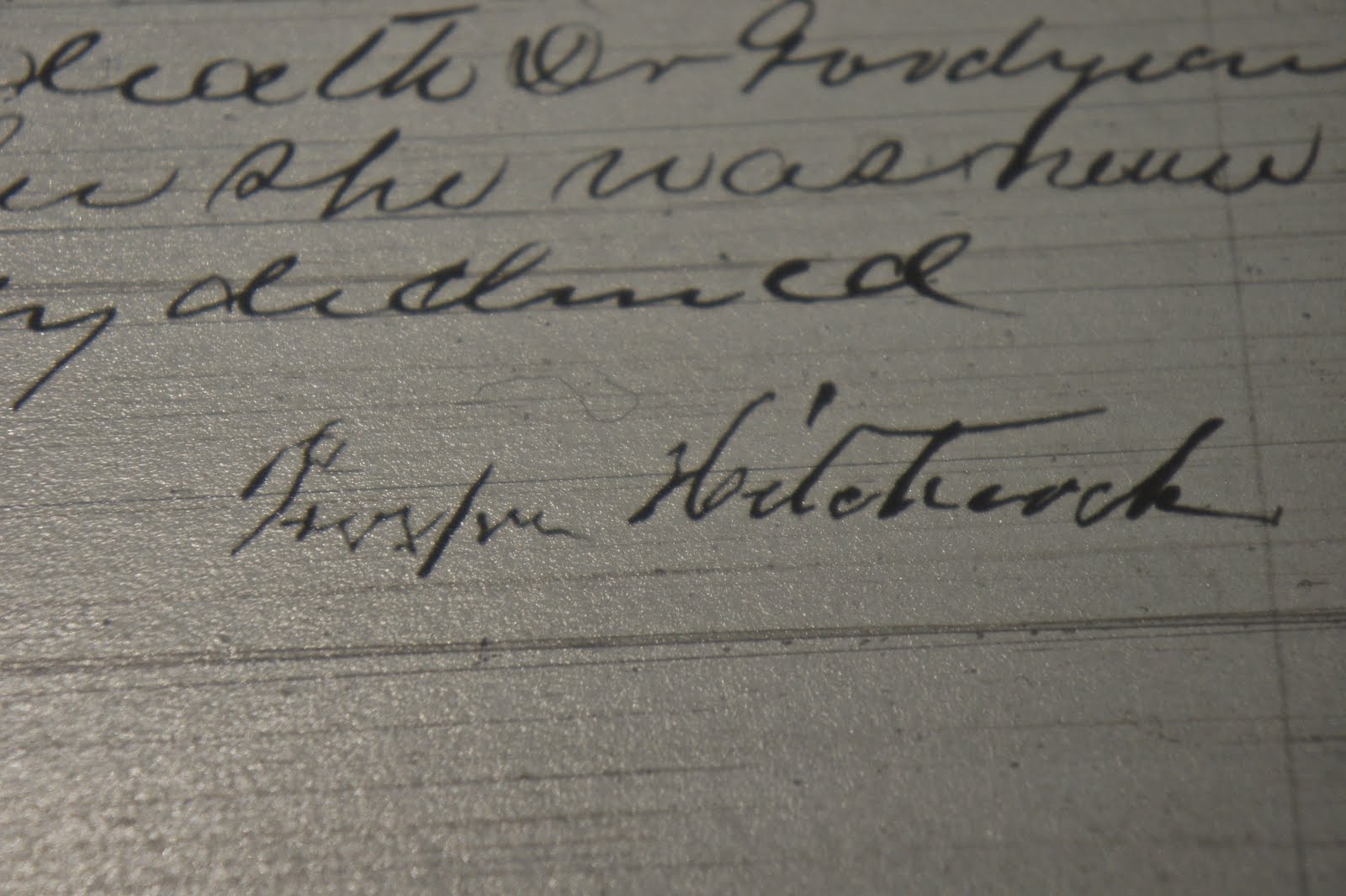
The Rev W.W. Doud published his work on the Doud family in 1885. His book has become the primary source for Doud research. But sadly for us, and by his own admission, it is very short on material for the family of Reuben and Polly. It is a thumbnail sketch at best, approximate dates, few locations, no source referencing. It is left up to us this generation of researchers to add more definition to the Family Tree of Reuben and Polly Griffin Doud. The recent recovery of the Will of their son Henry Doud has provided a gold mine of information. Henry Doud, although a widower, had no children. Henry was a successful farmer and rancher. At the end of his days with no children of his own he wrote a will that left his estate to the children of his sibling. According to court records “objections were filed to the Probate”. As a result of this action a hearing was held over a two-day span in March of 1870. As a result of this legal action Henry’s siblings were identified and or represented at the hearing. The essence of the testimony was that each witness testified concerning his connection to Henry Doud in other words they each gave a review of their genealogy. The witness list also included Henry’s only living sibling Reuben G. Doud who identified all of the members of Reuben and Polly’s family. This event provides a lot of information that we can use to fill in the gaps in the history written by the Rev. W.W. Doud. The information contained in the testimony has proven to be very helpful in establishing firm dates and locations for the Doud children. Following up on these leads we have been able to find death records and in some instances birth dates for Reuben’s children. The following is a synopsis of the sworn testimony. ------ The court clerk noted that Henry died October 8, 1869, he then entered the following list of people named in the Will. For clarification we added the names that are in parentheses. “The will written October 23, 1869 Henry Doud late of Cortlandville; Reuben G. Doud, ( brother) Adeline Collins, Lavinia Townly, (Truman) Stephen Hitchcock, Gideon Hitchcock, Vesta Hitchcock, (Vesta) Griffin D Walton, (Polly) Reuben Harrington, Nathaniel Harrington, Fanny Dexter, Philena Vaughn, (Lois) Joshua Walton, Truman D. Walton, Harriet Parson, Caroline Ames, A.G. Fuller, (Polly) Ephriam Eldridge, (Azubah) Vesta Doud, (?) Enoch Doud, (Truman) Prosper Hitchcock, (Vesta). ----- Notes: A.G. Fuller was the husband of Polly’s daughter Susan. Their was no one representing Gaylord’s family but Eben’s son Lofonso provided testimony. ------The proceedings started with testimony from a number of witnesses who testified to the validity of the Will and Henry’s signature. This testimony came from members of the community who had known Henry for a long time. Almost all of the relationships had a connection to the cattle business. In reading the testimony I think most of us would come to the conclusion that the Doud brothers were involved in the cattle business on a fairly large scale. Every homestead had a few cows. The Doud brothers had herds of cattle. For those of you who grew up in ranching country you will clearly understand the distinction.------ Henry’s brother Reuben G. Doud added his testimony. “ I am a brother of Henry Doud deceased the following are brothers and sisters of deceased. Lois Harrington, Eber, Gaylord, Vesta Hitchcock, Polly Walton, Truman, Azubah Cetchum, and Reuben G. Doud. Henry is next older than myself. All of the brothers and sisters are dead except myself. Henry’s age at the time of his death was 72. My age is 70 next September”. ------Jabez Collins, husband of Truman’s daughter Adaline, served as an administrator for Henry’s affairs. From his testimony it appears that he and his wife were the primary care givers for Henry’s later years. Henry’s obituary states that he actually died at the home of Reuben’s son Samuel. From Jabez’s testimony it is my assumption that Henry suffered from a little dementia in his last years. Jabez testified that Henry was always worried about the now non-existent cattle. “I reside in this town and have since 1818. My wife is a niece of Henry Doud”.------Nathaniel Harrington “My mother was Lois Doud she was Henry’s sister. She resides in Stockbridge, New York’.------ Note: this is the first historical hint we have ever found concerning the city where Lois Doud Harrington raised her family.------Lofonso Doud, “Eber Doud was my father he is a brother of Henry Doud. Father died in the fall of 1853 at the age of 65 or 66 in Michigan. He lived in Michigan for 16 years previous to his death”.------“Lovinia Townley sworn says My father was Truman Doud he was a brother of Henry Doud’ My father died 42 years ago his children were, Almire Doud she married and is dead she married Edwin Cook and left 5 children, the next was Adaline she married Jabez Collins is alive, the next is myself, the next is Truman Doud who died without heirs, the next is Enoch H. Doud living, next is Bela P. Doud living, the next is Josephine wife of John L. Hommendien living she is 42 years old living west”.------Prosper Hitchcock, “My mother was Vesta Hitchcock a sister of Henry Doud”.------Each recorded segment of testimony was followed by the person’s signature. In most court documents the clerk merely writes in the names of the person involved who may or may not then add their personal seal. In this case we have the actual signatures from our family history. We have included signatures for Reuben G. Doud, Prosper Hitchcock and Jabez Collins.

Tuesday, January 8, 2013

Abraham Doud's Will 1718 to 1801

Reuben/ABRAHAM/ Abraham/Thomas/Henry Doude------- Abraham Doud was born April 25, 1718 and died October 28, 1801. He married Mary (Mercy) Bishop. The birth records for his children that we posted on the blog uses the name Mary. They raised their family in East Guilford, now Madison, Connecticut. Abraham and Mary had seven children together. Their oldest child was Reuben Doud; born in 1748 Reuben married Polly Griffin. Abraham’s children were Reuben, Anna, Ruth, Eber, Olive, Henry and Lemuel. Eber and Lemuel gave their lives in the Revolutionary War both dying in 1776. Abraham names his living children in his Will, Reuben and Henry and his married daughters Anna Bartlett, Ruth Dudley and Olive Wilcox. We have included his Will, which begins “In the Name and Fear of God Amen”. In the Will he writes a short passage concerning each of his children. The passages are introduced by the lines “And as such Temporal Estate as God hath been pleased to bless me with in this Life, I give Devise and Dispose as follows”. At the end of the second page you can see his signature. In the Will he writes “ I give and bequeath unto my Eldest son Reuben Doud his Heirs and assign forever all of the remainder of my land laying on the west side of the highway opposite my dwelling house which I have not heretofore given him by deed toward his portion”. Apparently Abraham had already deeded Reuben some of his property. To Henry he wills ”all my homestead land and buildings”. Henry lived out his days on the homestead which originally belonged to his grandfather also named Abraham. Reuben disposed of his holdings in Madison and moved his family to Cortland, New York around 1795. The probate package also includes a detailed page for each of Abraham’s children. We have included three pages, one each, for Reuben, Henry, and Anna.

Sunday, January 6, 2013

Congregational Articles of Faith

If you have the opportunity to view a volume of original records from one the Congregational Societies what you will find in the opening pages are a number of documents that record the oaths and covenants that each member pledges to accept. One of those documents is their Articles of Faith. The Articles of Faith represent the tenants of Congregational belief reduced to their simplest form. This copy is from Madison, Connecticut. The heading reads, "These Persons all publicly assent to the following Articles of Faith and Covenant".