
Friday, January 4, 2013
Where were Reuben and Polly Doud's children born?
Establishing a birth date and a birthplace for the children of Reuben Doud and Polly Griffin has proven to be a daunting task. It has been so for most of the researchers who have taken up the challenge. The Rev. W. W. Doud published the most widely quoted Doud History in 1885. You can access a copy on the Internet. It is titled “The Descendants of Henry Doude, who came from England in 1639”. In the forward the Rev. Doud acknowledges that most of the information for the first three generation that he uses was gathered from the collections of Alvan Talcott a source we have referenced many times on this Blog. Alvan Talcott’s work has been organized into a two-volume collection titled “Families of Early Guilford Connecticut”. Talcott’s work however contains no information on Reuben and Polly. Starting where Talcott left off the Rev. Doud amassed a wonderful collection covering a number of succeeding generations. Concerning Reuben and Polly’s family he writes, “The descendants of Reuben were widely scattered, and it has been with much difficulty that the line has been followed at all, to say nothing of the imperfect condition in which it still remains. His children were” he then lists Eber, Gaylord, Lois, Truman, Azubah, Polly, Vesta, Henry and Reuben G. He also includes their spouses. For dates he has years only with no locations. From a review of subsequent material it would seem that most individual family histories written subsequent to his history have relied heavily on his material in particular the dates. Recent research efforts have provided a specific date for the death of almost all of his children and in a few instances we have also discovered a date of birth. But what we have not been able to find up until now is a definitive connection to a place of birth. Henry Doude was a founding father for the town of Guilford. His generations are connected to that place. As the original Guilford grew it was subdivided. The primary motivation was the establishment of new Congregational Societies. North Guilford became Bristol and East Guilford became Madison. In a recent detailed review of the early church records for Madison we found a baptismal record for two of Reuben and Polly’s children. On May 29, 1796 Vesta and Zuba, children of Reuben Doud, were baptized. Reuben purchased his first piece of property in Cortland, New York in late 1795. It is my assumption that he moved to Cortland at about that time and began to organize a farm and homestead so that he could bring his family to New York at a later date. This pattern of colonization that was very common. In the meantime Polly had the two youngest girls baptized. I remain puzzled as to why there is no records for the other children in Madison.


Abraham Doud's Will 1691 to 1768
Reuben/Abraham/ABRAHAM/Thomas/Henry Doude------
Abraham Doud was born August 22, 1691 in Guilford, Connecticut. He married his cousin Sarah Doud and their marriage is posted on the Blog. On her death he then married Phebe Kelsey. His death is listed as March 12, 1768. Abraham and Sarah had four children Thomas, Abraham and two sons named Samuel the second Samuel named after a older brother who died in his first year of life. Abraham’s will is posted in 1768. In it he lists his wife Phebe and his two sons Thomas and Abraham and his grandson Samuel son of his son Samuel who had died in 1760. In the Will he leaves one–half of his real estate to Phebe with the caveat “as long as she remains my widow”. As was the legal custom of the time Phebe’s property would revert to Abraham’s sons on her death. To his “loving son” Thomas he leaves his land on Summer Hill except for 34 acres which he leaves to his grandson Samuel. To his loving son Abraham he leaves his “homestead where I now dwell”. His signature is affixed at the bottom of the second page. The Third page he have included lists his sons Abraham and Thomas at the bottom as the executors of his Will. The last page is part of the inventory of his estate.


Wednesday, January 2, 2013
Abraham Pierson's Notebook
Abraham Pierson served as a Deacon in the Killingworth Second Society from 1794 to 1823. The Deacons served as “chairman of the board” for the Society. The Congregational Societies, and thus the Deacons, set the tone for much of what went on in their communities. The Society was responsible for raising the necessary funds to meet the needs of the congregation. A salary and housing for the minister, funds to build and maintain chapels, schools, cemeteries and any number of other enterprises all needed funding. Consequently the Society was involved in the collection of tithing money among other revenue sources. In essence they were concerned with all matters pertaining to the maintenance of the religious life of the community. In all of this they were subject to some scrutiny by the state religious boards whose approval was required to establish a new Society. These boards were also responsible for the formal aspects of establishing a new Society, providing a stamp of authority, presiding over the inauguration of the new congregation and providing a quorum of ministers to ordain the new minister. But by in large, once established, individual Societies exercised a great deal of autonomy. With the Deacons acting as chairman key decisions were put to a vote by the membership who owned the covenant. A key aspect of their duties was the selection of a minister to meet the ecclesiastical needs of the members. The Ministers were all trained in the theological seminaries that were a major part of the leading universities. Choosing the right man was very important. But even though it may strike us as odd Societies had the power and were not hesitant to dismiss their Ministers if they found them wanting. During his tenure Killingworth had three Pastors. The first was the Reverend Henry Ely who served from 1782 to 1801 when he was forced to resign after a period of unrest that started with his request for additional living funds. He was replaced by the Reverend Josiah B. Andrews. The Rev. Andrews himself was eventually dismissed by the Society. The members took offence at his emphasis on their sinful nature. He was very much a minister in the vein of the “Sinners in the Hands of an Angry God” school of thought. He was followed by the Reverend Asa King in 1811. Reverend King became one of the most successful of all of the Pastors who served in Killingworth. While the Pastors, by the nature of their position as holders of God’s authority, were the dominant voice in the Society the Deacons enjoyed a great deal of influence and respect. In Abraham Pierson we have one of the most dynamic Deacons who served in any of the Societies I have studied. Abraham came from one of the most prominent families in Connecticut. His namesake had served as the Minister in the early days of Killingworth and went on to become the first President of Yale. Abraham, unlike many in his family, did not become a minister finding his own success in other avenues. He served as Justice of the Peace in Killingworth for thirty-two years. For a good portion of that time he also represented Killingworth in the Connecticut General Assembly. As a reflection of his own worldview he took offence at being referred to as Judge or Assemblyman instead he preferred the title of the “good Deacon Abraham” a circumstance that provides us with an insight into the importance of religion in Killingworth. He is buried in the Union Cemetery next to the Griffin Home Lot. In his role as Deacon he kept his own set of records in his personal notebook. The volume we have covers the years from 1794 to 1802 and contains 95 pages. It’s my guess that there was a second volume that covered the years up to 1823. What he chose to record also provides a commentary on the religious mindset of the people who lived in Killingworth. Since the notebook was his property on his death it remained in his family rather than becoming a formal part of the church records. It left his family’s hands finally to reappear a few years ago. The new buyer, recognizing its significance, donated it to the state library thus giving us access. Abraham’s notebook mirrored much of what was kept in official church records. This is important for us since some of the church records for that time period have been lost. He recorded births, marriages and deaths for which he added the note “In North Killingworth”. One of the baptisms is for Jeremiah Griffin Buell named by his grandmother, Thankfull Griffin Buell, in honor of her brother who died young. In his notebook he records of the death of his father Dodo. While most of the notations are cryptic the notation for his father contains quite a bit of detail including the time of day. In a death record for a child he added the note “never baptized” which to him was significant. He also kept an ecclesiastical record. He noted who was accepted into the all-important Full Communion and he had a section he labeled “Covenanters” although I am unsure about his distinction between the two. He also had a section that he labeled as “Acknowledgements” which were in essence public admissions of sin as an act of repentance. The most common acknowledgement was for the sin of fornication by a married couple. This was not about “adultery”. The issue was a desire to avoid being numbered among the sinners in God’s eyes. Fornication occurred when a couple found themselves deriving too much of the pleasures of the flesh in their intimate life together. Among the acknowledgements we also find drunkenness, quarreling, and breach of the peace. Abraham even kept a week-by-week record of the scriptural texts chosen by the Pastor as the subject for the week’s sermon. On January 3, 1802 the text came from Ecclesiastes 5:1 “Keep thy foot when thou goest to the house of God, and be more ready to hear, than to give the sacrifice of fools: for they consider not that they do evil”. Can you picture the good Deacon nodding his head in approval? During his time as a Deacon the Griffin family was represented in the Second Society by the families of Worden and Azuba Griffin, the wife of Henry Davis, and for a short time Charlotte Griffin and her husband Ancel Jones. His notebook also records the marriage of Mercy Griffin to Itamar Pelton. It is Abraham Pierson’s gift to us that we find a record of their families in his notebook. His notebook also gives us a wonderful view of the life of our Congregational ancestors.


Friday, December 28, 2012
Truman Doud son of Reuben Doud 1788-1828
Truman Doud son of Reuben Doud and Polly Griffin, was probably born in Madison Connecticut, East Guilford, about 1788. He moved with his family to Cortland, New York sometime around 1795. His brief obituary appears in a Cortland newspaper dated August 23, 1828 “Truman Doud d. this town, 21st inst, age 40”. He married Rhoda Hotchkiss they raised a large family of 7 Children in Homer, New York, Almira, Adaline, Lavinia, Truman, Enock, Bela, and Josephine. The towns of Homer, Cortland and McGraw all shared common borders. The three Doud brothers Truman, Henry, and Reuben G. were listed in census records as “dovers”. The town history records that Truman was responsible for driving large herds of cattle from Pennsylvania. Their are multiple references to buildings that were built of bricks manufactured by Truman Doud’s brick works. His brother Reuben G. owned and operated the local grist mill. Among the land deeds there are a least a dozen land records involving Truman. In one he is buying 4 ½ acres for sixty-five dollars. In another he is selling property valued at one thousand dollars. He and his wife Rhoda are listed together on a few of the deeds. The signatures we show were probably written by the clerk with Truman and Rhoda adding their seal.


Abraham and Mary Bishop Doud / Reuben's Date of Birth
Abraham Doud was born to Abraham and Sarah Doud on April 25, 1718. He married Mary Bishop. The birth records for their children, including Reuben, can be found in the original town records of Guilford. Reuben, Anna, Ruth, Olive, Eber and the twins Henry and Lemuel. Some records list Mary’s name as Mercy. From these records it is clear her name was Mary. The various Doud histories included several different dates of birth for Reuben. A close examination of the original town record shows the date to be February 25, 1748. The dates are in somewhat of a chronological order with the dates on the two consecutive pages ranging from 1747 to 1749. When viewing the original record you can clearly make out that the date is 1748 and not 1743 or 1745. Reuben married Polly Griffin June 24, 1779 in Killingworth Connecticut. Doud histories written in the 1800s state that he died in 1805 in Cortland New York.


Thomas and Abraham Doud Documentation
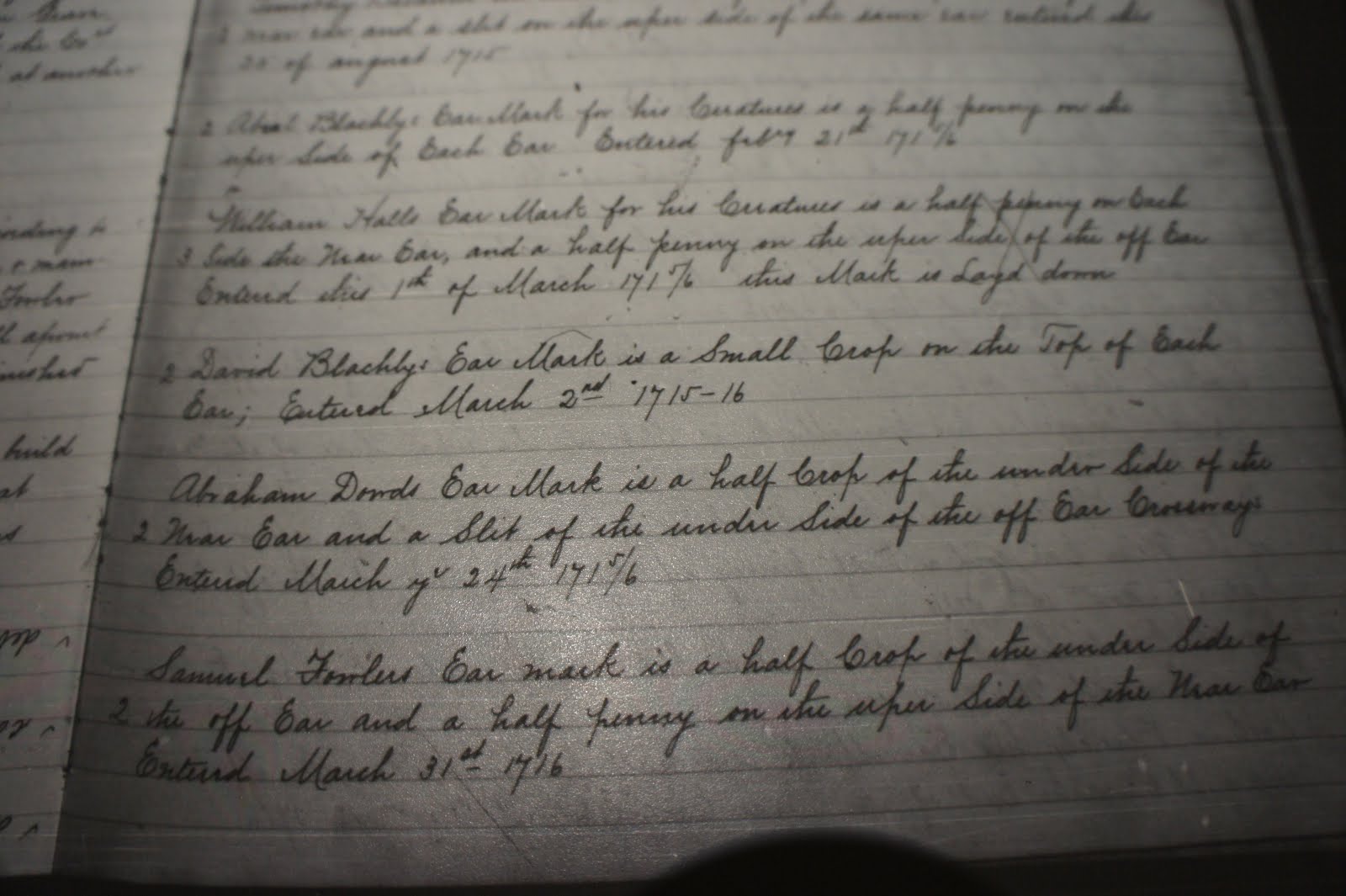
Thomas Doud, son of Henry Doude, was born in England making the journey to America with his father. He married Ruth Johnson on December 11, 1679. I have also added the birth records for Thomas and Ruth’s sons Joseph and Abraham. Abraham, born August 22, 1691 was Reuben Doud’s grandfather. These records are from the same volume that contained the “burial” record for Henry Doude. Thomas's death record is found within the pages of the original town records.Also presented is the registration of the earmarks used by Abraham. Registration of the earmark used by each man was essential since the use of a common grazing ground was part of the design of most New England towns. Abraham married his cousin Sarah Doud on May 1, 1712 their marriage is also found in the original Guilford town records. Reuben/ Abraham/ ABRAHAM/THOMAS/Henry.



Henry Doude Documentation
Henry Doude’s name is found on numerous pages in the recorded history of Guilford. I have included here the record of his death. The record is found in one of the earliest town records that include some very early wills and the earliest vital records. Judging by the style of writing I think it may be a transcription of an early record that no longer exists. On the other hand the court records and wills suggest that it may be in fact the original record. His death or “burial” is recorded as 31 August 1668. On the same page is the death notice for his son Jeremiah. Note his name is spelled with an “e” on the end Doude. I have also added a court document that includes his name.


Subscribe to:
Posts (Atom)