Charles Emerson Griffin------------
A Biography-------------
Bradley Orlo Griffin-----------
Preface--------
Charles Griffin was born in Essex, Chittenden County, Vermont on May 10, 1836. He died at Antimony, Utah on July 18, 1900 on a return trip to his home in Escalante, Utah. His life journey took him first to Munson, Geauga County, Ohio then on to Nauvoo, Illinois. Charles with his family joined the Mormon migration to Utah. The family lived in Winter Quarters until crossing the plains in 1848. Charles then made his home in Utah until his death in 1900. At the age of 46 Charles wrote his autobiography. He wrote,
“I write the following sketch of my life thinking perhaps some of my posterity may look back as I do at the present time and feel that they would like to know something of their ancestor’s history.”
“I dedicate this sketch to my children, wishing all to have access to it and each to have the privilege of copying it if they wish.”
The autobiography that Charles wrote is, to quote him a mere “sketch” of an incredible life. It is the autobiography of a very humble man. Living among the giants of his age he did not picture his life as being that dramatic. The testimony of time argues otherwise. He was deeply involved in many of the definitive moments in early Utah pioneer history. Our hope for this project is that we might be able to fill in the untold gaps in his story.
Using his autobiography as a template we have attempted to gather information from the diaries, journals, histories and accounts of the people and places that shared his experiences. We have in our files copies of all the documents that are referenced in the work.
Honoring Charles’ wishes we hope that this material is shared with all of his posterity.
Charles shared much of his life with his father Albert Bailey Griffin. In many ways this is also his father’s story. ------------
Contents-----------
1- Essex to Munson
2- Nauvoo
3- Winter Quarters
4- Crossing the Plains
5- Salt Lake City 1848
6-Church Farm
7-Life Guards
8-Handcart Companies
9- Utah War a Historical Fiction
10- Black Hawk War
11- Gunpowder
12-Education
13-Coalville
14- Long Valley
15-Coalville 1866------------
Chapter-1 Essex to Munson-----------------
Charles Emerson Griffin started his original autobiography by writing, “I write the following sketch of my life thinking perhaps some of my posterity may look back as I do at the present time and feel that they would like to know something of their ancestor’s history.
Being now a little over 46 years of age and not having kept a journal of my life, I shall have to write from memory with the exception of a few dates that I have of incidents of my life.
Having no knowledge of my ancestors farther back that my grandparents, I shall not attempt to guess at their history, but hope that before I die I may be able to trace back and get the genealogy of my forefathers.
I dedicate this sketch to my children, wishing all to have access to it and each to have the privilege of coping it if they wish.
My name is Charles Emerson Griffin, son of Albert Bailey Griffin, who was the son of Samuel Griffin. My mother’s named was Abigail, daughter of Paul and Ann Varney, I was born in the town of Essex, Chittenden County, State of Vermont, May 10, 1836.”
In a letter written to his son, Charles Emerson, late in his life Albert Bailey Griffin declared that he like his son was born in Essex, Vermont.
Charles represented the fourth generation of Griffins to live in Essex. His great grandfather, also named Samuel, arrived in Essex from Killingworth, Middlesex County, Connecticut in the 1790’s along with his three sons John, Daniel and Charles’ grandfather Samuel Griffin Junior. Samuel Senior and his sons represented the original pioneers in Essex. They carved farms out of the virgin wilderness. This pioneering tradition was to follow Charles all the days of his life.
Charles’ grandfather Samuel Griffin Jun. married into one of the most prominent families in Essex that of Deacon Samuel Bradley. Deacon Bradley was a leading citizen in Essex playing a major role in the dominant force in the community the Congregational Society. He was a genuine hero of the Revolutionary War as was the family of his wife Abigail Brownson.
Samuel Griffin Jun and his wife Sylvia Bradley carved a home out of the wilderness staring with the original Lot 81 purchased by Samuel on his arrival in Essex. Lot 81 was on the western edge of Essex in an area referred to as the Lost Nation. Over time Samuel Jun expanded his holdings purchasing a number of properties that surrounded the original home lot. The original home lot ran up the river bottom of Indian Brook. It is prototypical “bottom land” rich and productive. The landscape rises suddenly up from the river bottom for a hundred feet or so. The original Griffin house stood in the plateau that bordered the river bottom. By the time Charles was born the family had moved up the hill to the next adjacent lot where they build a new home that looked down over the original homestead. Charles was born and spent the first year of his life in the original house on the original homestead. Charles’ father Albert was the fifth of nine children born to Samuel and Sylvia Griffin. Albert married Abigail Varney, daughter of Paul Varney and Anna Austin, probably sometime in 1825. The Varneys and Austins were originally from Quaker stock having lived for multiple generations in Dover, New Hampshire before parts of the family moved to nearby Colchester, Vermont. The first child born to Albert and Abigail was a son Sidney born December 15, 1826. Sidney only lived until the age of four. A second son, Albert Bailey was born August 19, 1830 and survived only a few days.
From the surviving family histories and traditions and a collection of letters written by Albert’s siblings we get a picture of a very close knit farm family of modest means. In letters addressed to Albert later in his life we read such sentiments as, “Yours with a sisters love”, “ My long absent but not forgotten brother”, “I received a very kind letter from you in due time …. Will you imagine my joy at reading a few lines from you, it really did seem like old times, I clasped it to my lips and raised my heart in prayer to God, to thank him for once more hearing by letter from you”. The sources describe a farm that had cattle, sheep and hogs. There are references to fruit trees and maple groves. The deed records show that the family had the means to continually acquire additional property as they expanded their holdings. We have descriptions of old houses and new houses as the family upgraded its living conditions. Everywhere is the description of cutting timber and clearing new land.
This was the extended family that welcomed a new baby named Charles Emerson May 10, 1836. Greeting Charles and fussing over him for the first year of his life were his grandparents, Samuel and Sylvia Griffin, his Bradley aunts and uncles, his great Griffin Uncles, his married Aunt, Zilpha Griffin Day, and his father’s older brother Orlo and his family. Still living on the family homestead was his uncle Harrison and three aunts who undoubtedly fussed over him to no end Sylvia, Rosetta and Electa. Two older brothers, Philemon and Minor, had lived to see Albert married but died before Charles was born. It appears that the family worked the acres together. Orlo bought a small home lot from his father on which to build his home.
As was the common pattern in an early America, where almost everyone made a living by farming, there came a time in every community when the land for new farms simply ran out. When that happened we see a generation of young men moving on to the next frontier. In Essex that generation was Albert Bailey’s and the next frontier was the Western Reserve in present day Ohio.
The three Griffins left Essex probably in May of 1837. We get hints for that date from letters written to Albert when he was living in Utah from his sister Rosetta, “We can look down and see the house and farm where we all lived when you went away almost 37 years ago the 1st of May or about that.” In another letter she wrote, “Charles when I think of you it is as a boy one year old with sore cheeks and your hands done up to keep from scratching them.” From these descriptions we can imagine a picture of the extended family gathered around a fully loaded wagon one probably build by Abigail’s father Paul Varney to say their goodbyes. Charles notes that the Varneys, Paul his wife Anna Austin, their daughter Artemisia, and three sons, William, George and Paul Hamilton, also moved to Munson, Ohio. Staying behind were Albert Varney and his sister Ester. It would seem logical that they all traveled together but Charles is unclear on that point.
By 1837 there was a well-established route from Essex, Vermont to Munson, Ohio. It is a short days ride from Essex to the shores of Lake Champlain at Burlington. The well-established Lake Champlain Trail stretched south down the east side of the lake from Burlington, Vermont to Whitehall, New York, at the southern end of the lake, and then on to Albany, New York a distance of 150 miles. Albany had been the capital of New York since 1797. By 1836 the population was well over 10,000. Albany had served as a major trade center since well before the Revolutionary War. As such it had served as the hub for a number of roads. One of the major roads ran from Albany via Utica to end up at Fort Oswego on Lake Ontario. Starting in 1794 the State of New York started building a road, referred to as the Great Genesee Road, from Fort Schuyler in what is now Utica to Canawaugus on the Genesee River a major north-south link in central upstate New York. In 1798 the legislature authorized a road extension to Buffalo on Lake Erie. By 1808 the route, by then called the Seneca Turnpike, had been vastly improved and macadamized along its entire length. Turning the route into a toll road funded the project. The Erie Canal had been completed in 1825 bringing another level of connections to upstate New York. Another road, the Lake Shore Path, stretched from Buffalo, along the shore of Lake Erie, all the way to Cleveland, Ohio. Munson was but a short detour south from the Lake Shore Path. The author of one of the earliest histories for Geauga County noted that most of the early residents had arrived via the Lake Shore Path. The distance from Essex, Vermont to Munson, Ohio via this route was 620 miles. The route was over well establish and in some portions greatly improved roads. There were a number of towns that offered rest and resupply on the route. Given the traveling conditions on this route I would estimate that it took the Griffins not much longer than 35 to 40 days to make the trip via wagons.
Charles describes the Munson years in his autobiography.
“Charles Emerson Griffin son of Albert Bailey Griffin who was the son of Samuel Griffin. My mother’s name was Abigail, daughter of Paul and Ann Varney. I was born in the town of Essex, Chittenden County, State of Vermont, May 10th 1836.
When I was about one year old my parents moved to the State of Ohio, in the township of Munson, County of Geauga (now Lake) about twelve miles from Kirtland, where the Latter Day Saints, or as they were called Mormons, had a State and had built a Temple.
My father bought a farm and followed farming for a living. We lived here for six years. I attended school from the time I was three years old until I was seven and learned to read and spell very well for one of that age.
During that time my Grandfather Samuel Griffin visited us and I have a faint recollection of him and how he looked.
My mother’s parents had also moved to Ohio and resided a short distance from us and I visited them often.
My mother had three brothers, William, George and Hamilton. The two former died quite a number of years ago. Hamilton moved to Michigan where he was living some seven years ago. My grandfather and uncles were all wagon makers that is the Varneys.
I think it was 1842 that some Mormon Missionaries came in to our community and held some meetings. They were the first I had ever seen or heard of. I recollect of going with my parents to hear them preach. My father invited them home with him after that the elders always made our house a stopping place when they came into the neighborhood.
My father and mother were convinced of the truth of Mormonism and joined the Church of Jesus Christ of Latter Day Saints.
My father sold out and was preparing to move to Nauvoo in the state of Illinois where the Saints were gathering when we heard of the Martyrdom of the Prophet and Patriarch Joseph and Hyrum Smith. I well remember the taunts and slurs cast at me by my school mates after my parents joined the Mormons, and when the news came of the death of the Prophet and Patriarch they were worse than ever in trying to aggravate me and they very often succeeded to the extent that I would often resent it with blows, and many were the combats I had with them. After my parents joined the church they made a visit to Kirtland were a few of the families of the Saints lived and I of course being their only living child accompanied them. My mother had two other children, both older than me but they had died in infancy. While in Kirtland we visited the Temple and I have at present time a very good recollection of how it looked.”
Munson was part of the Western Reserve, land held by the state of Connecticut. In 1795 a large part of the holding was sold to developers. The lands were called survey lands. The federal government surveyed the land into 36 square mile blocks, which were subdivided into 640-acre sections with sections set aside for schools etc.. In the case of Munson the squares were only 25 miles. Munson was the 8th township in the 8th range. Munson was divided into 3 tracts and each tract was divided into lots. The point of the survey lands was to provide structure to western expansion. It was a way to provide title to land and encourage growth. This area was settled early in the development of Ohio because of its easy access to Lake Erie and the Lake Shore Path. Munson was one of the last townships in the 8th range to be settled because it was the most mountainous. Its geography had a great influence on how the people made a living. With its higher elevation it was blessed with abundant supplies of running water. The township supported a variety of water-powered mills, sawmills, carding mills and gristmills. It was also described as great grass county. Because of this it became famous for its dairy herds and dairy industry. Beef cattle were also raised and exported mainly to Pennsylvania. Another range-based industry was sheep including a brand of Moreno sheep raised for their great wool.
The Munson that the Griffins arrived in was part of Geauga County. In the 1840 Census for Geauga County we find listed Albert B Griffin. His age is listed as between 30 and 40 as is the female in the house. Also listed is a male child under the age of five. Geauga County was organized on 1805. By 1813 a county court house was build in Chardon. Munson was surveyed into lots in 1816. By 1818 there were only 4 families living in the township. The 1830 census counted 354 residents while the county as a whole had 7,916 residents. The histories for Geauga County describes the area as densely forested when the first settlers arrived. It took some time to clear large amounts of farmland. In the mean time the residents supplement their larder with the wild game that was abundant in the area including, elk, deer, bear and turkey. The principal farm crops were, wheat, corn, potatoes and oats. The area early on became well known for its orchards of pears, apples and sugar maples. The area became a very successful farming area with the first of the famous county fairs being held in 1823.
The Griffins started, as did most immigrants to the area, in neighboring Newbury Township one of the first townships in the area to be settled. We find a deed record dated August 29, 1838 in which Albert purchases 50 acres in Lot 29 from Samuel Hale. The purchase price was $700.00. A survey of land costs suggests that this was for an already established farm. The Griffins had arrived in Ohio in the Spring of 1837. A common pattern was to lease or rent a piece of property and then purchase ground later on. It is my estimation that that was the pattern that the Griffins followed. Albert quickly turned around and sold the property in September for a $50.00 profit. I think Albert on arrival in Newbury leased the farm with an option to buy. He bought the farm a year later and sold it with the improvements he made for a $50.00 profit. It is my guess that he then followed the same pattern in Munson.
Albert Griffin made his first purchase in Munson in October of 1839. Over the next several years he bought and sold portions of Lot 10 in Section 3. His first purchase was for 35 acres at a cost of $165.00. The 35 acres were at the top of Lot 10. Over the next several years he bought and sold parts of the 65 acres that represented the middle part of Lot 10. The cost of the top part seems to indicate that it was unimproved ground. The price on the middle part was $1000.00. In all likelihood that price reflected the purchase of a working farm. Although portions of the Munson Township are mountainous Lot 10 is comprised of beautiful flat farm county. Rich Amish farms now occupy much of the county. The local school and beautiful town parks now occupy Lot 10. The property is at the intersection of the Bass Lake Road and the Mayfield Road.
According to the Geauga County Histories most homes in the era were frame homes due to the ready availability of finished lumber. The picture that I imagine is a successful working farm that was being continuously upgraded. Ohio with its superb canal system offered farmers a wide access to markets and top dollar for their harvest. The farmers in Ohio were not just subsistence farmers they also raised cash producing crops. In the case of the Griffins hints are that that crop was sheep. I picture the family living in a comfortable farmhouse. Frame houses were easier to construct and in comparison to their log counterparts usually larger and multi storied.
Charles wrote that his Varney grand parents lived near by. The deed records show the Varney brothers only purchasing home lots of one acre. Charles noted that the Varneys were wagon makers a fact reflected in the 1850 census. The 1850 census shows the family of his uncle Paul Varney, with Charles’ grandfather, Paul, as part of the household, living in Munson listed as wagon makers. I estimate that it is less than a mile between the two households. Charles notes that he visited the Varneys quite often. Their home lot sets near one of the streams flowing through the area. The location was probably selected to place it closer to the sawmills and the finished lumber they needed to make wagons. Speaking of his grandparents Charles also recorded the visit of his grandfather Samuel Griffin from Essex, Vermont. I find it quite remarkable that his grandfather would make such a journey. In a light buggy that could make good time I estimate that it was still a three-week journey both ways
The singular event that forever changed the life path for the Griffins occurred, according to Charles, sometime in 1842. According to his description the family attended a number of meeting held by the Mormon missionaries. He then wrote,
“My father and mother were convinced of the truth of Mormonism and joined the Church of Jesus Christ of Latter day Saints.”
According to his description from thence forward the missionaries were frequent visitors to their home. He describes the first meeting between the Missionaries and the family as being in 1842. From the manner of his writing it seems that it was some time latter when they actually joined the church. Some records list a baptismal date for his parents in 1842. The Seventies records list it in July 1843.
Charles offers no insights into the nature of their church life in Munson. Nearby Kirtland had been the headquarters of the Church beginning in 1831. In 1836 the Kirtland Temple had been completed. In 1837 and 1838 the majority of the church members in Kirtland had left for Missouri. For the next three year there had been a struggle over leadership in the Kirtland Stake and control of the temple. By 1841 a major reconciliation between the membership in Kirtland and the church at large had occurred. 1842 saw a large surge in baptisms in the area. Charles’ autobiography seems to indicate that the family may have only made a single trip to Kirtland and the Temple. In 1841/42 Joseph Smith had issued a call for the Kirtland Saints to join with the body of the Church in Nauvoo.
There are no records of a branch of the church being formed in Geauga County. With only a limited number of visits to Kirtland the majority of church life for the Griffins may have been limited to visits by the missionaries. We know for a fact that at least one of their neighbors, Alfred Randall, had joined the church. It is not unlikely that there were others. This small group would have tried to meet together each Sunday. The Book of Commandment had been published in 1835. It is very unlikely that the Griffin house did not contain a Bible before they met the Mormons later to be joined by the Book of Mormon. I suspect that the majority of their church life in Munson was limited to family study of those three books of scripture.
It was not easy to be a seven-year-old Mormon in Geauga County. There was a good deal of resistance to the Mormon Community in Ohio. The religious and political establishment resent the intrusion of the new sect and the growing Mormon influence. The church and its leaders experienced a lot of persecution. There was also a large amount of controversy surrounding the failure of the Kirtland Bank. The local newspaper, published in the county seat, Chardon, was very vocal in its opposition to the Mormons. As a result Charles describes being tormented about his Mormonism by his schoolmates. The future soldier, Indian fighter and sheriff noted his response to their taunts,
“I would often resent it with blows, and many were the combats I had with them.”
His response gives us a little hint at a hard as nails seven year old boy his life shaped by the demands of frontier life.
Not long after their conversion to the Mormon faith the Griffins made the decision to move to Nauvoo and join with the body of the Church. Albert began to dispose of his property. After all of his property transactions Albert had ended up with fifty acres of property for which he had paid $365.00. As the family was leaving Munson he sold the remaining fifty acres to Asher Fowler for $600.00. In Nauvoo the Griffins had to acquire draft animals and a wagon. I think that when they left Munson in addition to their farm ground they also sold most of their farm equipment and animals as well as their house. This, along with the profits from the harvest that summer, and what every other monies they had accumulated represents the nest egg that they would use to reestablish themselves in Nauvoo. This time it was the Varney family who saw them off on the canal barges for the journey to a new home.
References; www/samuelgriffingenealogy.blogspot.com, www/griffinsofessex.blogspot.com


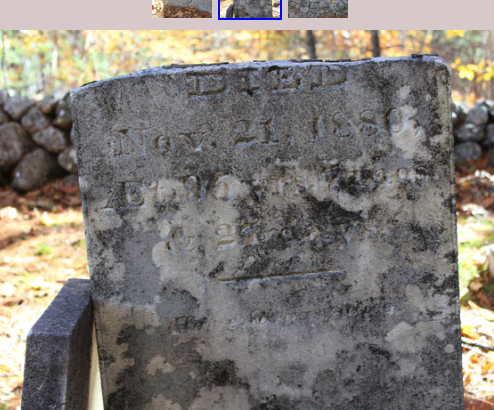


 Jane was born July 21, 1827 in Tuftonboro, N. H. she died March 11, 1884 In Portsmouth. Jane married J. (John) Newell Bassett November 5, 1865 In Tuftonboro. The record indicates it was a second marriage for both. Jane’s first marriage is probably the reason she is not in the 1850 census. The marriage record lists Jane’s parents as James and Jane Tuttle. Jane’s death record is found in the New Hampshire vital records. It records her death March 11, 1884 in Portsmouth. It gives her age as 56 years 7 months and 21 days. It notes that she was born in Tuftonboro to James Tuttle and Jane Edmonds. Jane is buried in the Lakeview Cemetery in Wolfeboro. John N Bassett’s will was probated in February 1880 in Tuftonboro.

