Sunday, December 4, 2016

Samuel Griffin 1776-1851 Essex, Vermont

The birth of Samuel Griffin Jun. is recorded in the ledgers of the Killingworth Congregational Second Society; the date is March 17, 1776. Samuel grew up with his ten siblings on the home lot on Roast Meat Hill Rd. His three older half sisters, Lois, Polly and Azuba were married and in their own homes by the time he was a teenager. Life in the Griffin home was probably centered on the large room that made up most of the first floor of the house. A large fireplace, that covered much of one wall, dominated the room. All of the family’s meals were prepared in the fireplace. During the rest of the day it served as the heat source for the home. In the evening I suppose that it provided the light for schoolwork. ---------- Samuel’s father made his primary living in his joiners shop. The homes in Killingworth are all wood frame houses. There is a rich tradition of fine woodwork in their exterior trim and interior finish. Lumber is a common asset listed in many of the wills I have reviewed in Killingworth. All of this speaks to the Griffin boys helping their father in his carpentry business. ---------- The original home lot was surround by a modest amount of farmland. I am sure Samuel was involved in all of the activities that a farm boy is usually exposed to. You can still identify the foundations for a barn and a corncrib on the home lot. The living history of Killingworth is filled with stories of butchering hogs and making sausages. There are reference to fruit trees and cranberry bogs and mince pies. In the history of the extended Griffin family there are references to cider presses. Milk and cheese were surly a part of everyday fare. The animal power to run the farm is more likely to have been oxen than horses. In the wills and land deeds it is common to find references to acreage dedicated to pasturage. With six brothers in the household it is quite likely that there was enough rough and tumble to suit any young man trying to measure his boundaries. ---------- Life in North Killingworth was centered on the Congregational Society. His father Owned the Covenant meaning the family were members in full standing. Sundays involved going to a series of meeting that took up most of the day. Society records noted that one of the activities that the society was involved in was managing the local schools. His firm signature that is found in the deed records is an indication that Samuel spent some time in those schools. It is my own personal fantasy to imagine the boys sitting by the fireplace listening to the stories told by their father of his exploits in the French and Indian War as he worked his loom. --------- Samuel’s Aunt Thankful Griffin Buell and her large family lived a short distance down Roast Meat Hill Rd. In addition his uncle James and his family lived in South Killingworth. Given all of the hints of the closeness of those early New England families I am sure Samuel enjoyed a good deal of cousin time. ---------- It was the young men of Samuel’s generation who were faced with the reality that the continuous expansion of Killingworth has reached its inevitable limit. For the young men of his generation the oldest son inherited the family farm and the rest of the boys in the family turned their eyes elsewhere to make their fortune. For the young men of Killingworth elsewhere was New Hampshire or Vermont. ---------- Joel and Asahel were the first to leave. They are listed in the 1790 census in New Haven, Addison County, Vermont. John joined a group that surveyed the Essex, Chittenden, Vermont Township. With John marking the way by 1800 Samuel Griffin Senior and his three sons, Samuel Jun, John and Dan were all settled in Essex. Their sister Mercy and her husband Ithamar Pelton joined them. ---------- Samuel Griffin Sen. purchased Lot 142 in the large central valley that dominates Essex. His sons John and Dan joined him on his new farm. Samuel Jun on the other hand purchased Lot 81 in the area known as the “Lost Nation”. From the Bicentennial History of Essex, ---------- “In the western part of the town nicknamed Lost Nation by the early settlers, beginning on the Reservoir road opposite the Moses Yandow farm the first farm was settle by Samuel Griffin. His house was on a knoll on the south side of the road where the foundations are still visible.” --------- The majority of Lot 81 ran down the bottomland created by Indian Brook. While more rugged in nature the bottomland was made up of some of the richest land in the township. Both father and son acquired addition properties adjoining their original lots both eventually building up large successful farms. ( See Blog June 2014) --------- There is a headstone in the Essex Common Burial Ground that puzzled family historian for a long time. It sat next to Samuel Griffin Senior and his wife Mercy. It is damaged and hard to read. A transcription read, --------- ” Zilpha Griffin – June ye 11, AD 1799– In memory of – wife of Samuel Griffin Jun’r- in the 48 yr of her age. “ --------- The listed age of “48” did not compute if she was the wife of our Samuel Griffin Jun. The mystery was solved with the discovery of a set of records documenting the family of Samuel Buell found in the Essex town records. The record listed the death of Zilpha Buell on June ye 11, 1799. A bit of basic research on the family of Samuel Buell reveled the fact that he had lived in Killingworth Connecticut with the Griffins. The baptism of his daughter Zilpha is record there on Aug 12, 1781 making her age 18 not 48 at the time of her death. ---------- Thus it appears that Samuel Griffin married Zilpha Buell in Essex in 1798/99 with her death following soon after. After her death Samuel took as his second wife Sylvia Bradley the daughter of one of the most prominent men in Essex, Deacon Samuel Bradley. There is no record of their marriage but it probably occurred in the spring of 1800. --------- The birth of Sylvia Bradley is found the land records in Sunderland, Vermont. It notes that “Silvey” was born Feburary 23rd, 1783, the daughter of Samuel Bradley and Abigail Brownson. Her father moved the family to Essex in the 1790s. ------- Samuel and Sylvia built up a large farm that seemed to be quite adequate in its ability to provide for their needs. Life was such that Samuel was able as an older man to join in the fight during the War of 1812. We can find in the military records an entry that reads, --------- “Samuel Griffin 3 Reg’t (Tylers) Vermont Private” ---------- Samuel and Sylvia had nine children together all of whom survived to adulthood. The children are listed in the baptismal records of the Essex Congregational Society; Zilpha, Philemon, Minor Bradley, Orlo, Albert, Harrison, Sylvia, Lois Rosette and Electa Celinda. ---------- The first child born in the family was a daughter who they named Zilpha probably born about 1801. I find it curious that Samuel would ask his second wife to name a daughter after his first wife. Zilpha married David Day III. They had a family of eleven losing all but four of their children at an early age. The family lost two boys, Edgar and Albert in the Civil War. Zilpha and David also died young. They are buried in the Essex Junction Village Cemetery. Her headstone reads,” Zilpha Day Died 15 Feb 1843 wife of David Day III”. David died in 1845. --------- Philemon was born September 4, 1803. There are a few land deeds between Philemon, the oldest son, and his father Samuel as father tried to help a son get a start in life. Consumption took Philemon at an early age. From the Burlington Sentinel, --------- “In Essex, April 15, of consumption, Philemon Griffin age 25 years. --------- His headstone reads, --------- “In Memory of Philemon Griffin who died April 15, 1829 in 26 year of his age”. -------- Philemon married Anna Mariah Sanford. There is no evidence that the couple had any children. Anna eventually remarried. --------- Minor Bradley Griffin was born probably in 1804. He carried his mother’s maiden name. Minor too was destined to die as a young man. His headstone reads, --------- “In Memory of Minor Griffin who died Oct. 2, 1830 in the 26 year of his age.” --------- Minor married Sarah Ann Hinckley. Again there is no evidence that the couple had any children. --------- Orlow Bronson Griffin was born in March of 1807. His marriage to Hannah Thompson is found in the Vermont Sentinel, --------- “Essex, VT Orlo B Griffin and Hannah K Thompson married 16 Apr 1830”. --------- Orlow and Hannah had 15 children together six are buried in the Griffin family plot in the Essex Common Burial Ground as unnamed infants. Two other children died at a very young age. Orlow purchased a three-acre home lot from his father near his father’s house. It is my read on history that they farmed in concert with an eye toward Orlow eventually taking over his fathers land. However fate intervened with an early death for Orlow. He died June 6, 1851 at the age of 44. We have a number of postings on the Blog for his son David Brainard. -------- The next child born in the family was Albert Bailey Griffin. Albert carried his grandmother’s family name. Albert was born February 28, 1809. Albert married Abigail Varney from Colchester in about 1825. The couple had three sons, Sidney who lived until the age of four, Albert Bailey who survived only a few days and Charles Emerson. Albert was the only sibling to leave Essex moving to Munson, Ohio. In Munson he joined with the Mormon movement. He eventually moved to Nauvoo Illinois and then became a part of the Mormon migration to the Rocky Mountains and Utah. In Utah Albert participated in the Mormon tradition of polygamy taking as a second wife Laura Emily Beebe. The couple had seven children together. Albert is buried in Kanarraville, Utah his death occurring February 11, 1896. --------- In 1895 Albert wrote a letter to his son Charles in which he related elements of his family history; --------- “I was born and you was in Essex Chittenden Co. Your mother was born in Colchester Chittenden Co. joining Essex on the West. Colchester lays on Lake Champlain joining Burlington city and Essex to. Your grandfathers folks were Quakers ( refering to his wife Abigail) ---------- I got a letter from my brother Catty Harrison he is a cripple with rheumatism 82 years old. My sister Lois Rosetta Hunt lives in Essex very poor heath. Electa Celina my youngest sister lives in Nebraska were a number of Counties have lost their crops and have to be helpt. Sylvia Fuller and her husband are both death the lived in Essex.” A photograph of Albert is posted below. --------- Harrison Griffin was born in 1812/13. Harrison married Phebe S. Larkin. Together they had seven children. Of the seven children only two survived to adulthood, Ella and Ida. There are five small headstones in the Griffin family plot in the Essex Common Burial Ground that lists 4 unnamed sons and one daughter the children of Harrison and Phebe Griffin. --------- After Phebe’s early death Harrison took Sylvia M. Baker as his second wife. Together they had two children Dan and Mariah. There is a family history for a date of death for Harrison December 12, 1890. The death of both of his wives is duly recorded in the Essex town records but there is no such record for his death. There is also no record of his place of burial. However there is evidence that he was still living at the time of his wife, Sylvia's, death in 1895. In that same year, 1895, his brother Albert made reference to his still living 82 year old brother Harrison in a letter to his son Charles. An item found in the Death Certificate for his son Dan, identified as Daniel B Griffin, noted that he was buried in Essex Junction. There is no record for Dan in the Essex Junction cemeteries. When the original township divided between Essex Center and Essex Junction Harrison’s farm was found in Essex Junction. I have a suspicion that on that property is a small family graveyard. Harrison helped manage his mother’s affairs in the later years of her life. -------- Sylvia G Griffin was born November 26, 1814. In 1840 she married Willard Fuller. The couple had five children together. Their primary residence was Cambridge, Vermont. Her death is found in the Essex town records under the year 1890, ---------- “December 12- Sylvia Griffin Fuller- female- married-heart disease- (Born) Essex- Samuel & Sylvia Griffin”. --------- Sylvia is buried in the Essex Junction Village Cemetery. --------- Rosetta Lois Griffin was born March 30, 1818. She married Eleazer Hunt. The couple had five children. Evidence from the land records indicates that the Hunts purchased land from her father. Her death is recorded in the Essex town records. It is found under the year 1898, “Feb 25-Lois Rosetta Griffin Hunt”. It lists her age as 79 years, 11 month and 7 days. Her cause of death is “Exhaustion “ from the results of a broken thigh. Her parents are listed as ”Samuel & Sylvia Bradley Griffin. She is buried in the Essex Common Burial Ground. Rosetta kept up a lengthy correspondence with her brother Albert in Utah. From one of the letters; --------- “I am blest with a kind husband good home and enough of the world to make me comfortable which is worth a great deal to me ………dear brother let us live the life of the Christian that we may dwell together in the world to come is the prayer of your sister it is the heart that God looks at and not the name. I enjoy the peace of mind that this world can neither give or take away and it is a help to me in getting through this world of sin and sorrow.” --------- Electa Celinda Griffin was born October 21, 1820. Electa married Chauncy Wolcott. The family had three children together making their home in Colchester. Electa described herself in a letter dated September 12, 1882, --------- “I am quite fleshy you see. I weigh 182lb short and stubby, pretty fair looking they say for a women of 62 years old the 21st day of Oct.” --------- Electa and her husband Chauncy followed her two children, Sarah and Sidney, to Webster County, Nebraska. Chauncy died in Cowles Nebraska in 1885. Some family tradition places her death in Mt. Clare, Nebraska sometime after 1889. However there is a letter that she wrote to her brother, Albert that is date January 1895. In the letter she provides some details of her life. After the death of her husband, Chauncy, Electa made the move to Nebraska. She wrote that she lived alone in Cowles, Nuckolls Co. Nebraska for six years before remarrying. She identifies her new husband as Mr. Conant. In the 1895 letter she wrote that they had moved from Cowles to Mt Clare, which was 14 miles north. Those towns are now located in Webster County Nebraska. --------- From the surviving family histories and traditions and a collection of letters that have survived written to Albert in Utah by his siblings we get a picture of a very close knit farm family of modest means. In letters addressed to Albert later in his life we read such sentiments as, “Yours with a sisters love”, “ My long absent but not forgotten brother”, “I received a very kind letter from you in due time …. Will you imagine my joy at reading a few lines from you, it really did seem like old times, I clasped it to my lips and raised my heart in prayer to God, to thank him for once more hearing by letter from you”. The sources describe a farm that had cattle, sheep and hogs. There are references to fruit trees and maple groves. The deed records show that the family had the means to continually acquire additional property as they expanded their holdings. We have descriptions of old houses and new houses as the family upgraded its living conditions. Everywhere is the description of cutting timber and clearing new land. The children all seemed to have an attachment to the family farm. The deed records show that they all sought to purchase a part of the farm from their father later in his life. --------- Religion was also a strong theme in the family. Many of the letters exchanged between the siblings have a religious tone. All of the children were baptized in the Congregational Society. But, we also find in the Congregational records a notation that each of the Griffin’s had had “Fellowship Withdrawn” in 1844. It seems that the Griffin family had all joined the Methodist congregation led by family friend George Whitney. (Blog April 2016 Griffin’s at Butlers Corners) ---------- Samuel Griffin died September 19, 1851. His wife sent the news to her son, Albert, living in Utah via a letter; ---------- “Underhill, VT May 30, 1852 --------- Dear Beloved children I now will try to write a few lines to let you know that I have not forgotten you o, No your mother has not forgotten you altho time seems long and the distance great yet tis good to received a letter from you tho directed to Harrison. Was glad to hear that you were all well now. Albert you understand that there has been great changes in your family, yes indeed there has. Your father is no more with us he fell asleep in Jesus we trust last Sept 19th. He was worn out by sickness pain and ditness, he made his will and fixed the affairs to leave. Sold the land, some to Orlo’s two boys and some to Wolcott and took notes for cash but reserved a home for me in the house that you built having settled his business he said I give all up. I give myself up I shall soon know what it is to die. You may wonder why I am at Underhill, well I will tell you, Sylvia Fuller lives there and so I live with her and family. I came here last Jan. my health is not very good I feel the infirmities of age hasting on and soon, very soon, I shall be gone when a few more greifs I have tasted, but I will not murmur nor repine. God has lead me through so far and I trust myself with him, he is the same yesterday, today and forever, yes Albert although I may wander and stray yet God is true and has marked out the way that we should follow his steps and has said be thou faithful unto death and he will give a crown of life. This from your mother and friend Sylvia Griffin.” ---------- In his will ( Blog May 2014) Samuel names four of Zilpha’s children, Edgar, Ellen, John and Albert Day. He names Orlow’s two boys, David and Henry. He does not mention all of his other grandchildren. The logic seems to be that these grandchildren had already lost their parents and a grandfather was looking after their interests. He names three of his children, Electa Wolcott, Sylvia Fuller and Harrison Griffin. ---------- Sylvia Bradley Griffin died February 10, 1873. Samuel and Sylvia are buried in the Essex Common Burial Ground. They are buried in a row with Orlow, Philemon and Minor. The Griffin plot is also populated with small headstones marking the burial place of their numerous grandchildren who all died in infancy. Samuel’s parents, his brother John, and two of his children, and his first wife, Zilpha are buried together in a separate part of the Cemetery.

Wednesday, November 23, 2016

Eber L Bradley 1828-1910

Eber L Bradley left behind a very small documentary footprint. One of the few documents for him is the 1910 census taken in Malheur City, Oregon. The census records an Eber Bradley, age 81, born in Ohio, his father born in Vermont. Making the connection between the Eber from Malheur and the Eber the son of Eber Bradley born in Butler County, Ohio would be almost impossible if it were not for a very nice little biography written of him in a Malheur County History. According to the history Eber moved to Malheur in 1867. This raises the question, Why does he not appear in other census records. The answer lies in the fact that Eber was the census taker for Malheur. If you look at the 1880 and 1900 census pages you will see that they are signed by, Eber L Bradley. It is interesting that he did not include himself in the census data. The history notes that he never married. It paints a picture of him as one of Malheur’s leading citizens. Malheur was a typical western town that grew up around a gold strike it is now a ghost town its only trace is the small cemetery the home of 160 souls one of them, E L Bradley. ---------- Eber 1828 Butler Ohio / Eber 1802 Essex, Vermont / Harding 1776 Guilford, Ct,

Monday, November 21, 2016

John Harding Bradley, 1828-1873

Eber Bradley married Elsea Rynearson October 30, 1827 in Hamilton, Butler County Ohio. The 1840 census taken in nearby Milford notes that Eber Bradley was the father of seven sons. The family history provides a list of their names ; Eber Jr., John, Frank, Fernando, Jacob, Abraham, Garrett, William and Stephen. Working backward from the few know dates of birth you would expect John to be born in 1828/1829. ---------- Census records track Eber to Huron/ Yellow Spring/ Benton, Iowa. At one time or another a single location went by those three names. The Iowa census records note that the Bradley family arrived in Iowa in 1843. A biographical note for William Bradley notes he moved to Iowa with his father in 1843. John does not appear in the Iowa census records with his father. Tracking him has proven to be a distinct challenge. Evidence for him is circumstantial. But the evidence never the less is quite compelling.--------- There is a rich trail for a John H Bradley in California. He appears in the 1870 census in Township-2 Santa Barbara, Ca. The census noted that he was 42 (1828 ) born in Ohio. That area would later become Ventura, Ventura County. John H Bradley became a well know citizen in venture. In 1871 he founded the Ventura Signal the area’s first newspaper. ---------- Probably due to his standing in the community his cemetery record is quite detailed; Born Oxford, Butler, Ohio, 16 March 1828. Died Ventura, California 11 September 1873. He is buried in the Cemetery Park in Ventura. Oxford and the Milford from the 1840 Ohio census for the family of Eber Bradley are subsets of the same location. There are bits and pieces of John’s history scattered on the various genealogical web sites. Most quote his grandchildren as the source of the material. Noted as John “H” Bradley in various historical references his grandchildren remember the “H” standing for Hardin/Hardon. In all likelihood the “H” stood for Harding his grandfather’s name. There is a line that is quoted from his obituary, “he removed to Iowa with his father in 1843” ---------- So he have a John H Bradley born in the same location as the son of Eber Bradley, in the year that we would have supposed, moving to Iowa with his father in the same year that history records Eber, arriving in Iowa, the bearer of a distinctive Bradley family name. What are the chances that John H Bradley is not the son of Eber and Elsey Bradley? ---------- John Bradley married Sarah Ellen (Nellie) Newby December 7, 1865 in Linden, San Joaquin, CA. --------- John / Eber / Harding / Stephen / Stephen / Stephen of Guilford, CT

Sunday, November 20, 2016

Franklin M Bradley 1831-1919

Within the family history of the family of Eber Muzzy Bradley ( 1802 Essex, Vt) and Elsa/Elsey/Eliza Rynearson is a list of their 9 sons. Eber, John, Frank, Fernando, Abraham, Jacob, Garrett, William and Stephen. The census records support the existence of the 9 sons. The 1840 census, which lists seven sons (William was born 1842, Stephen 1844), and the marriage record for Eber and Elsa (1827) identifies Butler County, Ohio as the birth place for the first eight sons. The 1856 census for E. M. Bradley taken in Huron, Iowa provides the names and age for the last six. Clearly identifying the first three sons poses a challenge. This is certainly true for, “Frank”. ---------- As you search through the census records for possible candidates for an older Frank Bradley you find a “Franklin Bradley” age 29 ( 1831), born, Ohio, in Benton, Iowa in the 1856 and 1860 census. Benton is the same small town where Eber is found in 1860. With a date that matches what we would expect for “Frank” and a birthplace of Ohio and residence in the same town as his supposed father it seems a pretty safe conclusion that we have found father and son. ---------- The 1856 Iowa census list the number of years each person has lived in Iowa. The census indicates that Eber and his sons have lived in Iowa for 13 years. The 1856 census for Franklin also notes that he had lived in Iowa for 13 years. ---------- The start of the Civil War in 1861 disrupted the lives of the Bradley brothers. After the war they scattered to the far parts of the western United States. Tracking where they ended up is a genealogical challenge. This is certainly true for Franklin Bradley. An easily arrived at assumption is that the brothers would enlist in Benton or Yellow Springs. However the records we find are for Bradleys, that enlisted, are in Burlington, Iowa. The explanation is found in the records of the Yellow Springs Presbyterian Church. In the records for Elsey Bradley we find a notation that she “dismissed to the 1st Congregational Church in Burlington” in 1861 thus placing the family in Burlington. Elsey, Stephen, Garrett and Abram V. are all listed in the Yellow Springs membership records. ---------- We can trace Franklin to his time and place of death using his military records. Note that information from one record can be found in the other records. These points make it easy to follow the connection between them. The records provide a physical description for Franklin, his place of birth, where and when he enlisted, the units he served in, and his time of death. ---------- We have recovered an enlistment record, ----------- “Engr. Reg’t of the West—Franklin M Bradley—Age 30 (1831), height 5 9 1/2--- dark completion, blue eyes, brown hair--- born Butler Co, Ohio---Enlisted Sept 30, 1861, Burlington, Iowa. ---------- We have also recovered a set of more detailed service records; ---------- Franklin M Bradley---Military History; Enlisted Sept 30, 1861, Burlington, Iowa, 1 Mo Engrs, Reenlisted Jan 18, 1865, 4 U.S. V.V.----Domestic History; Born Ohio, 5 ft 9 inches, dark completion, blue eyes, grey hair, place of residence, Phillipsburg, Ks.-----Date of death Oct 13, 1919. ---------- We find a record of him in the, U.S. National Home for Disabled Volunteer Soldiers in Leavenworth, Kansas in 1919. ---------- There is also a record for his burial in the Leavenworth National Cemetery. “Bradley, Franklin M, 4 U.S.V.V. Oct 13, 1919.” ---------- The military records place Franklin in Phillipsburg, Kansas late in his life. Franklin’s father, Eber, and his two brothers, William and Jacob, are buried together in the Fairview Cemetery in Phillipsburg. In the 1900 census in Phillipsburg we find William and Jacob. Also in Phillipsburg in 1900 is a Frank Bradley born May 1831 in Ohio. It would seem a given that we are looking at three brothers. However the census records add a bit of confusion, they note that Frank’s parents were born in New Jersey. A first reading of the record would lead us to reject this Frank as our Franklin. But also note that in the 1910 census for William notes that his father was born in Kentucky whereas the 1900 census noted that his father was born in Vermont. Anyone who was studied census records understands how fickle they can be at times. The 1915 Kansas Sate census notes that the 83 year old Frank Bradley born in Ohio came to Kansas from Iowa. ---------- The 1860 census in Benton lists Franklin age 29, Nancy Jane age 26, Henry age 6, Louis age 4 and John age 1. We should also note that Louis’s full name was Louis Harding Bradley, Harding being Franklin’s grandfather’s name. Death records for Henry and Louis, who eventual made their way to the Spokane, Wash area, list their parents as Franklin Bradley and Nancy Jane Humphrey. ------------------- Franklin / Eber Muzzy / Harding Bradley / Stephen Bradley

Tuesday, November 8, 2016

The Union Cemetery, Killingworth, CT, the Burying Yard

The Union Cemetery sits on the Roast Meat Hill Road in Killingworth. A stone fence separates it from the home lot purchased by Samuel Griffin Jr. in 1761. It is a beautiful little spot. The first time I visited the cemetery it supported a grove of tall stately evergreens. Many were knocked over in a storm 4 or 5 years ago. It is populated with very old headstone, many very weather worn. In the oldest section many are unreadable. There are 428 souls interred in the cemetery. It was actively used until the late 1800s. ---------- We find a land deed dated in 1784 in which Samuel Griffin purchases a small piece of property from the city of Killingworth that is identified as the "Burying Yard". The property is identified as being next door to other property owned by Samuel.There is a rich tradition of family cemeteries throughout New England. It is my assumption that with the burial of his wives Marah Griffin and Mercy Nettleton and a daughter Molle in the Burying Yard Samuel saw it as an eventual Griffin Family Cemetery. ---------- At the time Samuel made the purchase there were only a handful of people buried in the cemetery probably fewer than 25. That being said it was still a well know place in the area. In the land records, land deeds are referenced by their relationship to know locations rather than specific north, south, east and west coordinates. The “Burying Yard” was a common reference point for the land deeds in the surrounding area. ---------- In one corner of the cemetery is a small collection of older headstones that the years have erased the names. I have always assumed that the Griffins are buried there. The oldest readable headstone in the cemetery is for Mary Parmelee dated in 1744. Most of the early headstones are for the Clark, Parmelee and Lane families. Samuel purchased his original home lot located next to the Burying Yard from Benjamin Turner Jr. Benjamin’s father is buried in the cemetery he died August 31, 1751. Benjamin Turner Sr. was given the original land grant for the property that included the Burying Yard and the original Griffin home lot. It is my guess that it was he who started the cemetery. ---------- The cemetery has a strong connection to the Congregational Society. The Reverend William Seward, who officiated for the marriages of Samuel Griffin Jr. and his three wives, Marah Griffin, Mercy Nettleton and Mercy Bailey, is buried there. The Rev. Seward also baptized all of Samuel’s children. ---------- “Rev William Seward, died Feb 5, 1782, age 70.” ----------- We have made reference many times to Deacon Abraham Pierson and his influence in the Congregational Society that was home to the Griffins. He is also buried in the Union Cemetery; ---------- “Deacon Abraham Pierson, Rev War, died May 11, 1823, age 67 yrs”. ---------- Also buried in Union cemetery is Samuel’s sister Thankful Buell and her husband Nathan who died quite young in 1770, ---------- “Thankful Buell, wife of Nathan, died Feb. 16, 1816, age 85 yrs”. Her headstone is the last one posted. ---------- The Buell family lived but a short distance away on Roast Meat Hill Rd. The large Buell home was a local institution. It served at times as a tavern and a meeting place. ---------- In addition to Samuel’s family a good portion of his son, Worden’s, family is found in the Burying Yard. The headstones of Worden and his wife Rhoda Hull are found just over the stone fence from the home lot nestled up under one of the large trees. ---------- “Worden Griffin, died Feb. 17, 1847, age 75 yrs.” ---------- “Rhoda Griffin, wife of Worden, died Dec 9, 1848, age 75 yr.” ---------- Worden’s son Harmon and his wife and children are also buried here. ---------- “Harmon Griffin, died Feb 20, 1860, age 59 yrs.” ---------- “Betsey M. Griffin, wife of Harmon, died Feb 7, 1847, age 39 yrs.” ---------- “Charles H. Griffin son of Harmon & Betsey m., died Jan 15, 1829. ---------- “Eliza M. Griffin, daughter of Harmon & Betsey M., died Apr 11, 1830, age 28 days.” ---------- With the death of Harmon the Griffin family name ceased to exist in Killingworth Connecticut. By the time of his death Harmon and his father Worden had amassed about 500 acres surround the original home lot. ---------- Worden’s daughter Mercy Griffin and portions of her family are also buried in the cemetery. ---------- “Mercy Stevens, wife of Daniel died Jan 15, 1861, age 62 yrs.” ---------- “Daniel Stevens, died Mar 25,1866, age 71 yrs.” ---------- “Ellis M. Stevens, son of Daniel & Mercy Stevens, died June 2, 1839, age 9 mos.” ---------- “Harmon L. Stevens, son of Daniel & Mercy, died Apr 15. 1842., age 6 Yrs.” --------- Ellis and Harmon share a headstone. --------- Mercy Griffin Stevens named a son Samuel Griffin Stevens. A collection of letters that we found in the Connecticut State Archives titled, “Letters home to Daniel Stevens of Killingworth” provided us with rich insights into the Griffin family life in Killingworth. There are several essays on the Blog based on material from those letters. They introduced us to the family of Mercy Griffin Stevens. ---------- At some point in time ownership of the Burying Yard passed back to the city.

Saturday, October 22, 2016

Griffin home in Killingworth, CT

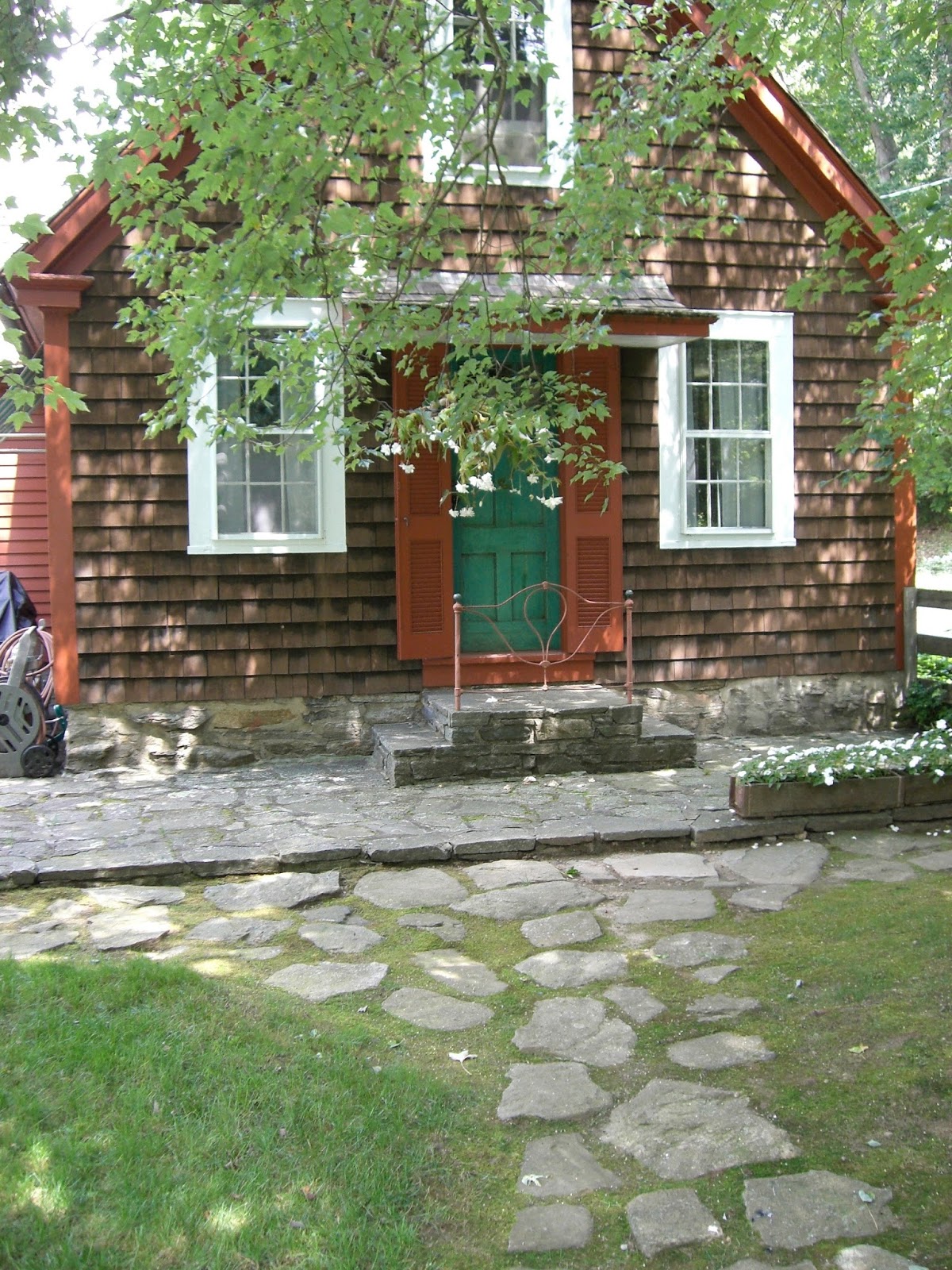
There is a renewed interest in cities like Killingworth in their historical buildings. Over the last few years they have been researching and publishing the history of their historical homes. It is particularly interesting to the Griffin family because many of these homes are from the same age as the original Griffin home on Roast Meat Hill Rd. We have included two homes as an example. We choose them because, both were constructed by members of the Wright family. Benjamin Wright built the oldest in 1710. Benjamin Wright is credited as being the first man to live in the Killingworth area. Benjamin Wright is also Mercy Bailey’s grandfather.---------- With very few exceptions these old homes are wood framed. All of them exhibit detailed woodwork in the window frames, doorframes, shutters, etc. The interiors also exhibit finely detailed woodworking. This use of wood provided a living for Samuel Griffin and his “joiners shop”. In our day men such as Samuel are referred to as cabinetmakers or finish carpenters. In that era such men were real craftsmen with everything being made from scratch using only hand tools. Samuel's large collection of joiners tools were divided among his sons in his will.---------- The typical house is the two story Benjamin Wright house. There are others that are referred to as a Half House. These lacked the full two stories. The Griffin house is a Half House. Even though it does not have the full two stories it does have a small upstairs room.---------- We have also reposted pictures from the original Griffin home lot and house. One picture is from a view in the Union Cemetery. This corner nestled next to the home lot is the oldest part of the cemetery. I think it is a fair assumption that Marah Griffin and Mercy Nettleton, wives of Samuel Griffin, are buried here.

Thursday, October 20, 2016

Samuel Griffin, 1757 campaign, French and Indian War

The French and Indian War ran from 1754 to 1763. The pivotal years were from 1757 to 1760. 1757 saw the French make their biggest push into the Colonies. In August of 1757 the French captured Fort William Henry, which gave the French a stranglehold over the Lake Champlain waterway and with it control of much of the region. In 1758 the British tried to retake the lost ground with disastrous results. The 1759 campaign saw the British Colonies retake much of the lost ground including the recapture of William Henry, Fort Ticonderoga and beyond. Samuel and his brother James played a part in the 1759 campaign.---------- But Samuel also served during the 1757 campaign season. The records for the Connecticut Militias that served during the French and Indian War are held in the Connecticut State Library. A print version of those records has been created. The records show that Samuel’s Regiment was commanded by Lieut.-Col Nathan Whiting. Col Whiting also had direct command over the Second Company. Samuel was a member of the Fourteenth Company command by Capt. Andrew Ward with Peleg Redfield serving as First Lieutenant. The Fourteenth Company was made up primarily of men from North Killingworth, CT. The pay roll records record Samuel’s time of enlistment as March 29. The records indicate that he served for 37 weeks and 1 day.---------- The Connecticut General Assembly had called for 1,400 troops for 1757. The main effort was to be concentrated in protecting the traditional route from Montreal, Canada to Albany New York. That route ran down Lake Champlain and then on to the waterway that extended south through Lake George. Fort William Henry sat at the southern end of Lake George. Its position made it a critical prize in the war. There were a series of other forts stretching back to Albany. Most of the 1,400 members of the Connecticut Militia were sent to occupy those forts. The remainder of the militia, about 500 men, were sent to Fort No-4 on the Connecticut River. That force was command by Col. Nathan Whiting. Samuel’s company was part of that command.---------- The area of Fort No-4 is now Charlestown, New Hampshire. In 1757 Fort No-4 marked the absolute margin of the frontier. The Connecticut River flows through Vermont, New Hampshire, and Massachusetts and on to the sea in Connecticut. The river and its tributaries served as the main artery to this entire region. With the war escalating the Connecticut River Way also became a major military prize.---------- There is very little that has been published describing the duties of the troops at Fort No-4 beyond noting that they were active in scouting and patrolling the region. There is an illustration of Fort-4 drawn by a contemporary of Samuel’s that has survived. There are however a number of accounts of the nature of the conflict with the Indian tribes. The tribes of the region aligned themselves with the French and pursed an active and savage strategy of raiding in the region. The most famous story to survive has been captured in a book published soon after the war titled, A Narrative of the Captivity of Mrs. Johnson. Mrs. Johnson and her family were captured at Fort No-4 and held in captivity for some time. After her eventual escape she published a personal narrative. The book includes allusions to the savage nature of the ”Indian depredations” common to the age and the area.---------- With so little to go on we are left to our imagination for an image of what life was like for Samuel during those 37 weeks. Everything beyond Fort No-4 was untouched wilderness. The first real road was not cut through the area until 1760. What the colonist described as wilderness was home to the Indian tribes. They moved through its vastness with ease. Can we not assume that their opponents, the young Samuel Griffin and his fellow militiamen, were also seasoned frontiersmen also at home in the open spaces? He himself was a weaver while at war did he wear homespun or leather? Did he carry a military issue gun of the Brown Bess model or did he carry one of the hand made long rifles that became the hallmark of the 1776 militiamen? ---------- James Fenimore Cooper was born in 1789 in Cherry Valley, New York an area that had been ravaged in the French and Indian War. He grew up among men, including members of his own family, who survived the events. He is famous for his books set in the French and Indian War time frame. His most famous work, Last of the Mohicans, is a description of the capture of Fort William Henry in 1757. I think it is a fair assumption that he was able to capture a fair amount of the reality of the life and times of the men like Samuel Griffin serving on the American frontier.