Thursday, May 8, 2014

Samuel Cornel Bradley a soldier in the American Revolution

Samuel Bradley was the 5th generation of Bradley’s to live in America. The first in his line to come to America was Stephen Bradley who arrived with his mother Elizabeth and siblings about 1642. Stephen married Hannah Smith. We have documented the identity of Hannah earlier in the Blog. Hannah is the granddaughter of Thomas Borne a contemporary of Miles Standish and Edward Winslow of the Pilgrim’s Story fame. Record of Samuel’s birth is found in Vol. 2 page 101 of the Guilford town records “Samuel Cornwell Bradley son of Stephen Bradley Jun. by Ruth his wife March ye 16th 1756”. Samuel was the son of Stephen Bradley Jun. and his wife Ruth Meigs. We have included the genealogist Alvan Talcott’s record of the family. He was the grandson of Stephen Bradley Sen. and his wife Jemima Cornwall. His middle name is in all likelihood derived from his grandmother’s maiden name. Jemima was the great granddaughter of William Cornwall of Middleton, Conn. In the records of Middletown the name is spelled in a number of different ways, Cornwall, Cornwell and Cornell. Spelled Cornwell in his baptismal record Samuel himself used the spelling of “ Cornel “. In Sunderland we find his name listed on the deeds as “Samuel Cornel Bradley”. A deed from his father reads, “I Stephen Bradley of Sunderland in the County of Bennington and State of Vermont in consideration of love and good will I owe to my son Samuel Cornel Bradley.” As a young man Samuel moved with his family from Guilford to Sunderland, Vermont. Samuel’s brother Eber in his family papers and autobiography provides some description of this time in the life of the Bradleys. By his account in about 1774 the family responded to advertisements placed in Connecticut newspapers for 45,000 acres of land for sale in Vermont. According to the ad the fishing was fine, excellent wheat land in the higher areas, first-class bottom lands, navigation and markets available. The trip to Vermont was an arduous one. There were no roads available to accommodate a wagon. When the Bradley’s got to their new home they found Sunderland was a frontier settlement, not large enough to be called a principal center of even a settled community. Frontier town or not Sunderland was destined to play a major role in the Revolutionary War. The names of Ethan Allen, Seth Warner, Gideon Brownson the rest of the Allen, Warner, Brownson and Bradley families, all Sunderland boys, are scattered through out the Revolutionary War stories from the Lake Champlain region. They made up the units referred to at the Green Mountain Boys and the Rangers of Fort Ticonderoga and the Battle of Bennington fame. The young Samuel Bradley was very much a part of this Revolutionary War history. Most of what has been written of his war history comes from the accounts provided by his brother Eber which have been preserved by his ancestry and published in a volume titled, Eber Bradley and some of his relatives, by Myron Bradley. The militiamen on the frontier did not join up for a specific period of time. It seems that the units were raised in response to specific needs. The length of service was dictated by how long it took to finish a particular campaign. Some times they were gone for two or three weeks at times for five or six months. Samuel’s first major campaign was with the forces commanded by an officer in the regular Continental Army General Richard Montgomery, which was aimed at capturing Montreal. From the history of his unit, “In June 1775, Samuel enlisted as a private in Capt. Gideon Brownson’s Company, Lt. Col. Seth Warner’s regiment raised as one of the four Regiments ordered by the Continental Congress………..He marched to Fort Ticonderoga from there he traveled to St. Johns, Province of Quebec, Canada. He participated in the siege of St. Johns ……..and then proceeded to and took part in the possession of Montreal. “ The “Rangers numbered about 174 men. They were attached to the main body of Continental solders led by General Richard Montgomery. They were used as scouts and as a counter to the Indian allies deployed by the British. The fighting between these units and the Indian allies was particularly vicious. After Montreal the Vermont units returned home. Montgomery chose to press the attack on to Quebec where his army met defeat and he was killed. Of his brother’s service Eber wrote, “Samuel went away in warm weather did not return till winter.” His service record indicated that he was gone for five months. In 1776 he enlisted for 27 days again with Gideon Brownson his future uncle. In July of 1777 Samuel enlisted in Col. Samuel Herrick’s Vermont regiment of Green Mountain Rangers. He served under Capt. John Warner. He served from July to December. In August of 1777 the unit played a major role in the Battle of Bennington. From the unit history, “On August 15th, the company marched on mass to Bennington where they slept on their arms that night. They participated in both actions the following day, the initial three-pronged attack against Burgoyne’s widely spread lines, and the following clash with the force of Hessians marching to reinforce the British after the initial defeat. The Battle of Bennington was the first major set back for Britain’s General Burgoyne, and a harbinger of things to come.” “After the Battle of Bennington, the company was stationed at Pawlet. From there, the members of the company continued ranging and performed guard duties over a cache of supplies. During the time they were headquartered in Pawlet, they participated in the attack to retake Fort Ticonderoga, and the capture of Lake George landing, the battle of Mounts Hope and Defiance on Sept. 19th, and the water borne attack on Diamond Island in Lake George on Sept 24th.” Samuel mustered out on December 3rd. Samuel enlisted again in 1778. On February 20, 1780 Samuel married Abigail Brownson in Sunderland. Abigail was the daughter of Amos Brownson, Gideon Brownson’s brother, and Dorcus Strong. Of the event Eber’s biographers wrote, “half a century later, Eber had not forgotten that transportation on the memorable day was by horse drawn sleigh.” Starting in 1781 Samuel, serving as a Lieutenant of the Sunderland Militia Company, he was called out on a number of short excursions. Later in life his wife was to testify “That she knows he was in service after their marriage and thinks he was several times but it is long since and she cannot remember how long and how many times.” The history of the Sunderland Milita notes ,”By 1784, Samuel Bradley was Captain of the Sunderland, Bennington County, Vermont Militia Company.” Samuel ended his service as Capt. in the Militia in Essex. Samuel himself gave some description of his militia service in his testimony before the Military Pension Board. “July 1832 Samuel Bradley resident of Essex in the County of Chittenden…..aged 76.” That I entered the service of the United States in the month of June 1775 in the company administered by Capt. Gideon Brownson and in the regiment administered by Seth Warner.” “July 1777 I enlisted as Sargent in the company administered by John Warner.” In response to the question of where he was born and if a record of his birth existed he replied, “I was born in East Guilford State of Connecticut in the year 1756.” “I suppose there is a record of my age in East Guilford.” “Question: Where were you living when…..into service, and where have you lived since the revolution?” Answer: I lived in Sunderland when I was called into the service and since the Revolutionary War I have lived in Essex, Vermont and do now.” In response to a question of whether or not he had served as a paid substitute for another he responded, “I was a volunteer in every instance.” Of the key Battle of Bennington he made the following humble statement, “I was at the Battle of Bennington, Vermont…. We had two battles in one day.” He was asked to name some of the officers under whom he served he named, General Montgomery, Col. Seth Warner, Col. Gideon Brownson, Maj. Safford, Col. Samuel Herrick.” Samuel and his wife Abigail moved to Essex, Vermont in 1787. In Essex he served as the first Capt. of the Militia. He was elected as town clerk a position he held for five years. The Congregational Society chose him to serve as Deacon a position he held until his death June 30, 1834.

Saturday, May 3, 2014

Abigail Brownson Bradley Nov 20, 1758-Dec 10, 1843

Standing in the very first row in the Essex Common Burial Ground are the headstones for Samuel Bradley and his wife Abigail Brownson. Arching across the top of the marble on Samuel’s headstone it reads, THE GRAVE OF. It then proclaims, Deacon, Samuel Bradley. It then records, Who died June 30th 1834, Aged 75 years. Across the bottom is the sentiment, “When lips are cold let marble speak. This day, O man thy Savior seak.” Arched across the top of her headstone is her name, Abigail. Then it records, Wife of, Dea. Samuel Bradley, Died, Dec 10, 1843, in her 86 year. Then the epitaph, “If bliss eternal you would share. While you have time for it prepare.” We would like to address in this article the historical identity of Abigail Brownson Bradley. ____________ The Brownson family has been the subject of a considerable amount of genealogical research. One collection in particular has come to dominate the discussion on our branch of the Brownson family. It is titled, Genealogy of One Branch of the Richard Brownson Family. Almost all of what has been written about Samuel and Abigail can be traced to this source, which is in and of itself a review of previous sources. In the Brownson history Abigail is identified as person B-70. From the history, “Abigail Brownson, youngest child and dau. of Timothy Brownson, Sr and Abigail Jenner, was born at Salisbury, Conn. Sept. 9, 1750, but the history of Woodbury says born July 15th, 1753; she died at Sunderland, Vt. Dec. 9, 1843. She was married to Samuel Cornwall Bradley, son of Stephen Bradley and Jennie Cornwall. He was born March 16, 1756, at Guilford, Conn. And died at Sunderland, Vt. June 30, 1834.” The history lists Abigail as the tenth child born to Timothy and Abigail Brownson. Their first child, Huldah, was born May 22, 1730. The ninth child, Eli, was born May 31, 1748 when his mother was 41. Several recent events have caused us to revisit the history of Abigail Brownson. The information on her headstone indicates a date of birth in 1757/8 not 1750. In 1758 her mother would have been 51. Curiosity concerning this seeming conundrum lead us to a review of the probate file, published in 1766, for Timothy Brownson which we have recently posted on the Blog. In a detailed will and probate file, there are a number of references to each of Timothy’s surviving children his daughter Elizabeth having died in 1861. However there is no mention of a child named Abigail. In the Barbour records there is a record for all of Timothy’s children. There is no Barbour record for a daughter named Abigail. This raised the question, Was there an error made somewhere in the Brownson history? There are some obvious clues. The history lists the place of death for the Bradley’s as Sunderland. As one of the most prominent couples of their day their history and death in Essex, Vermont is well documented. The history lists the parents of Samuel Bradley as “Stephen Bradley and Jennie Cornwall.” As you can discover in any number of Bradley histories and in the work of our oft mentioned Alvan Talcott Stephen and Jennie are Samuel’s grandparents. This raises the question, Were Timothy and Abigail our Abigail’s grandparents? The Brownson history accurately records Samuel and Abigail’s marriage and family history as found in the Sunderland records. The record is found in volume 3 of the land deed ledgers on the 6th page of the town records. The town records are numbered separately and scattered among the pages of the land deeds. The single entry is for the marriage of Samuel Bradley and Abigail Brownson on Feb. 28, 1780. The entry also records the birth of their first three children, Lecty, ( Later identified as Electa written as Leity in the Brownon history) Silvey (Silvia) and Theron. The researchers had missed the fact that in 1787 the family had moved to Essex, Vermont. So this then poses the question, If Abigail is in fact the granddaughter of Timothy and Abigail Brownson who are her parents? There are clues in the Brownson history. Timothy and Abigail’s oldest son was Amos Brownson born in Woodbury, Litchfield County, Conn. June 10, 1732. Amos married Dorcus Strong on December 12, 1757. The Brownson history lists a family of 5 including the oldest child a daughter named Abigail born November 20, 1758 in Woodbury. As is the case in many Connecticut towns, town clerks that came along a little later in the town’s history rewrote the original town records. What has survived in Abigail’s case is her birth record as rewritten and certified as a true copy by the town clerks. “Abigail ye daughter of Amos Brownson by his wife Dorcus was born November 20th 1758.” Amos moved his young family to Salisbury, with his father, where the remainder of his children were born. . Abigail’s birth is also found in the Salisbury records along with her siblings that were born in Salisbury. In the Brownson history concerning Abigail the writer also notes “m. 22/12/1795 (?) to Isaac Merwin.” The entry seems to indicate that the writer had information that indicated Abiagil had married and thought it may have been to Isaac Merwin. Most subsequent histories have recorded this marriage as a fact when the original writer posed it as an educated guess. This circumstance is probably the reason there has been little if any follow up on Abigail’s personal history. Later in the same Brownson history another contributor documents in detail the marriage of a cousin, also named Abigail Brownson, born March 17, 1777 in Bethlehem, Conn. designated as person B-167, to Isaac Merwin in Bethlehem, Conn. on 22/12/1795. Ancestry.com has any number of well documented pages on this couple. So if Amos Brownson’s daughter Abigail did not marry Isaac Merwin who did she marry as surmised by the Brownson author? The Brownson brothers played a prominent role in the American Revolution. Their war exploits are well documented. For example housed in the Library of Congress in its collection of material documenting the life of George Washington is a letter written by Gideon Brownson to General Washington. Because of their Revolutionary War exploits their family histories have received a good deal of attention. After his father’s death Amos moved his family to the area of Williston, Vermont in 1775. He is considered the founding father of Richmond, Vermont an area carved out of several townships including Williston. Because of the uncertainty of events relating to the growing conflict with the British Amos left Richmond to join his brothers Timothy Brownson Jr.and Gideon in Sunderland, Vermont where they became prominent members of the “Green Mountain Boys” and associates of Ethan Allen. After the Revolutionary War Amos returned to Richmond where he lived until his death. There are five pages is the Richmond town history dedicated to Amos's family. Concerning his daughter Abigail they write "Abigail, the oldest, was born November 20, 1758. She was 17 in 1775 when they went to Williston." Living in Sunderland during the years Amos lived there was Stephen Bradley and his wife Ruth Meigs with their family including their son Samuel Bradley. Samuel also joined the Green Mountain Boys along with the Brownsons. The early Sunderland town and deed records are replete with Brownson and Bradley references. Amos Brownson’s daughter Abigail was certainly with the family in Sunderland. Is she the Abigail Brownson who married Samuel Bradley? Luckily for us we have the testimony of an eyewitness to these events. __________ In 1832 the Congress of the United States passed a Pension Act for soldiers who fought in the Revolutionary War. Samuel Bradley applied for and was granted a pension. Later on the Act was expanded to grant benefits to the widows of ex soldiers. Among the collections held at the Vermont State Archives is a file for Samuel Bradley. The file includes a record of the appearance of his widow before the Probate Court to apply for widow’s benefits. What follows is her personal testimony before the court. “ Declaration of Mrs. Abigail Bradley. On this 17th day of July 1837 personally appeared Abigail Bradley of Essex, County of Chittenden in State of Vermont, before the Court of Probate for the said county, district who being first duly sworn according to laws do on her oath make the following declaration in order to obtain the benefits of the provisions made by the Act of Congress passed July 4th 1836. That she is the widow of Samuel Bradley late of Essex, county and State afore said a pensioner under the Act of Congress passed June 7th 1832, she further declared that she was born as informed by her parents and according to the records of the family on the 20th of November 1758 at Woodbury in the County of Litchfield and State of Connecticut that she married the said Samuel Bradley on the 28th day of February 1780 at Sunderland, County of Bennington……….. the marriage was solemnized by Timothy Brownson Esq. of said Sunderland (her uncle ). That she has lived ever since with the said Samuel Bradley until his decease June 30, 1834. That she knows he was in service after their marriage and thinks he was several times but it is long since and she cannot remember how long and how many times he was out after her marriage ………. For the Commission of Pensions to the declaration of her late husband in the Pension Office as the testimony here with enclosed she further declares she is yet the widow of Samuel Bradley sworn to and subscribed on the day. Charles Russell Judge.” Her signature is at the bottom of the document. As part of the proceedings she provided a copy of her marriage license. “Samuel Bradley was married to Abigail Brownson Feb 28, 1780, Abner Hill town clerk. Town Clerks Office Sunderland Aug AD 1837. I certify that the above is a true copy of record as examined by me. James A Graves Town Clerk”. _______________ In essence Abigail Brownson Bradley testified that she is the daughter of Amos Brownson and Dorcus Strong and the granddaughter of Timothy Brownson. It should then come as no surprise to find that Abigail named a daughter Dorcus after her mother. Dorcus is a biblical name that indicates a woman who abounded in good deeds. _________ The extended Brownson family has historically used a number of different spelling for their family name. Brownson, Bronson, Brunson. The spelling has changed from one branch of the family to the next . It is also changed from generation to generation. The Bronson spelling is now the most commonly used variation. In Abigail's family tree the name was always spelled Brownson.

Friday, May 2, 2014

Congregational Society Essex, Vermont

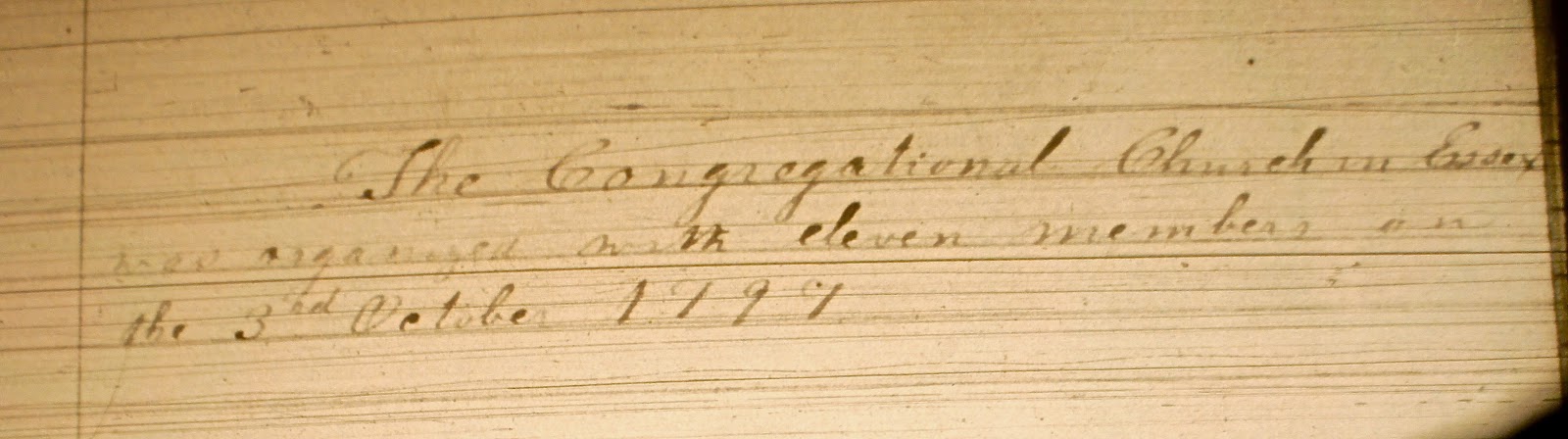
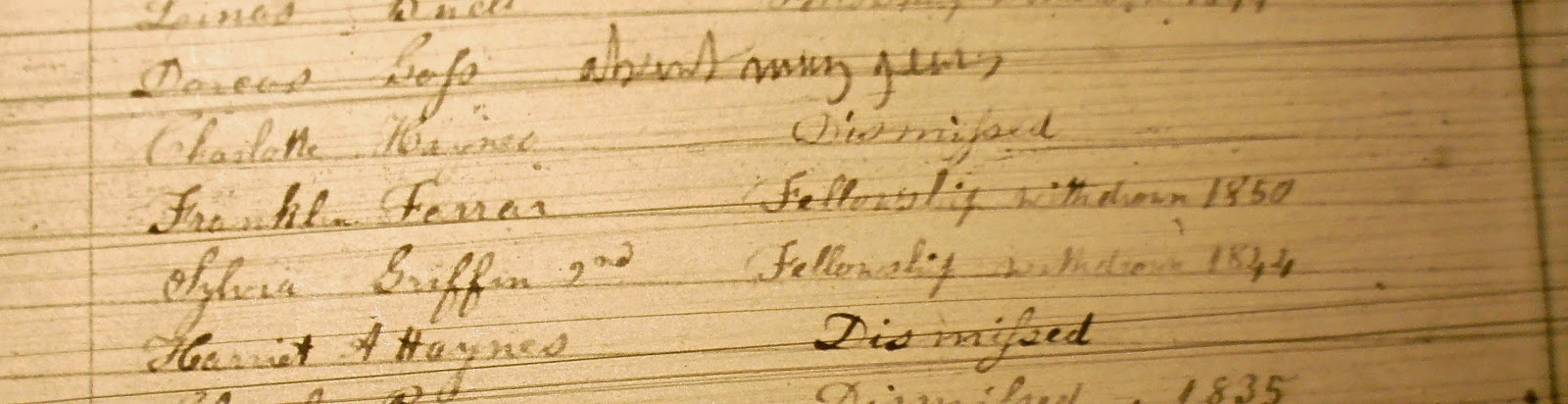
In the fly page of the ledger of the Congregational Society in Essex, Vermont is the entry “organized with eleven members on the 3rd October 1799.” A reference in the Essex town history indicates that the first meeting held to discuss the organization of the future Society was held in the house of Samuel Griffin."On the first day of April of the same year, in town meeting duly warned and held at Samuel Griffin's house, the first Ecclesiastical Congregational society was formed in accordance with the law of the state." There is another reference to Samuel in connection to the effort to erect a meeting house, "In January, 1802 the subject was again agitated, and David Kellog, Simon Tubbs, Samuel Griffin appointed a committee to "stick the stake and lay out the green where-on to erect said house" This committee happily agreed upon the present location." Scattered in the records of the Society we find the names of the extended Griffin families and their in-laws, the Bradley, Hamilton, Halbert and Day families. Samuel Griffin and Mercy Bailey are not found in the records however there is every indication that they were involved in the Society. We find their daughter in-law Mary Griffin (John’s wife) and her son Truman listed. Prominent in the Society records are the children and grandchildren of their son Samuel 3rd. Samuel Griffin 3rd married into the leading family in the Society, the Bradleys, when he married Sylvia Bradley. Sylvia’s father Samuel Bradley was one of the original eleven members. Samuel Bradley served as a Deacon for 30 years. As a hint of the status of the Deacons in these early congregations his headstone identifies him as Deacon Samuel Bradley. In the records we find scattered Samuel Griffin 3rd’s children. Zilpha, Minor, Philemon, Orlo, Sylvia, Electa, Rosetta The records seems to indicate that in 1844 Samuel’s family left on mass apparently to join a different congregation. A side note is that Samuel’s wife, Sylvia, rejoined the society founded by her father later in her life after her husbands passing. In the records we find Sylvia’s sisters listed, Ruth Bradley (Married name Payson), Dorcus (Bradley ) Hamilton, Electa (Bradley) Goss and Cynthia. Her sister Abigail’s family is listed under her husband Horace Halbert. Her brother Theron’s son Norman Bradley. In the section listing baptisms we have Samuel Bradley's children along with his daughter Dorcus and her husband David Hamilton’s family. We have Samuel Griffin 3rd and his son Orlo and son-in-law David Day (Zilpha). There were two ways to join a Congregational Society. The first was on a "Profession of Faith". Posted below is the "Profession" and the accompanying "Covenant". The second method was "By Letter". When a believer left one society and moved to another he was granted a letter from his original Congregation which he present to his new Congregation certifying that he had already made his "Profession of Faith". the new Congregation could then vote to accept him or her "By letter".