
Monday, July 9, 2012


Sunday, July 1, 2012
Asahel Griffin in New Haven Vermont
New Haven, Addison County, Vermont is a beautiful little farming community set in the rolling foothills of South Western Vermont. It started life as a legal entity in 1761. In 1761 there were probably very few, if any, people actually living in New Haven. What the 1761 action meant was that New Haven was now organized via the Probate Courts for the division and selling of property. The opening of Vermont to immigration was given a large boost by the French and Indian War. As a result of the war, trails had been built, and the territory had been more thoroughly explored. Returning soldiers, primarily from Connecticut, had made note of promising areas with an eye to future development. In 1760’s America land speculation was a major industry. The Crown and the Colonies filled their coffers by selling land grants. The action of 1761 opened the way for the New Haven area to be surveyed and organized for the sale of land. Groups of investors purchase large parcels which they then divided into manageable lots which they then sold to individuals. The real history of New Haven begins around the 1790’s when men like Asahel and his brother Joel bought 50 to 100 acre plots and began to carve out farms and communities from the raw wilderness. The 1790 Census finds Asahel and his young family in New Haven. He in all likelihood moved there and began life working as a laborer for someone else. He makes his first land purchase on September 14, 1791 from Reuben Field, one of the land speculators. It is recorded in the Land Deeds Volume 2, page 15. He made a second purchase on December 6, 1793 recorded in Volume 2, page 210. In the town history the history of each farm is traced back to its original owner. Asahel is shown as the original owner of a farm located in District 3. Clearing land for a farm was a harsh task in 1790. Vermont was and is heavily timbered. I think Asahel and his family spent a lot of his time cutting and burning trees but they were eventually successful testified to by the 15 plus years they stayed in New Haven. The story of why he left is yet to be written. We find record of him selling his New Haven property written on page 113 in Volume 5 of the Land Deeds, it is dated March 10, 1806. In Franklin County, New York we find him again accepting the task of carving a new life out of the wilderness.
-1- Map of New Haven, the town is organized into school districts. Asahel’s farm is in District No. 3
-2- District No. 3, Asahel’s farm is identified by the letter I.
-3- This is the original deed dated September 14, 1791.
-4- 1806 Land Deed.
-5- 1806 Land Deed.


Saturday, June 9, 2012
Stephen Kelsey and Lois Griffin
Lois/Samuel/Samuel-----Alvan Talcott, who lived in the 1800's, collected the history of many of the early families of the New Haven Colony. His files form the background for most studies on the genealogy of this region. After reviewing his collection it's obvious that he compiled his material from most of the primary source material available in the town and county records in the colony. Starting with one of the founding fathers he would list their children out for several generations. He would start by listing the children and if he had additional information he would add marriages, etc. This record for the family of Stephen and Lois is from his collection.

Thursday, June 7, 2012
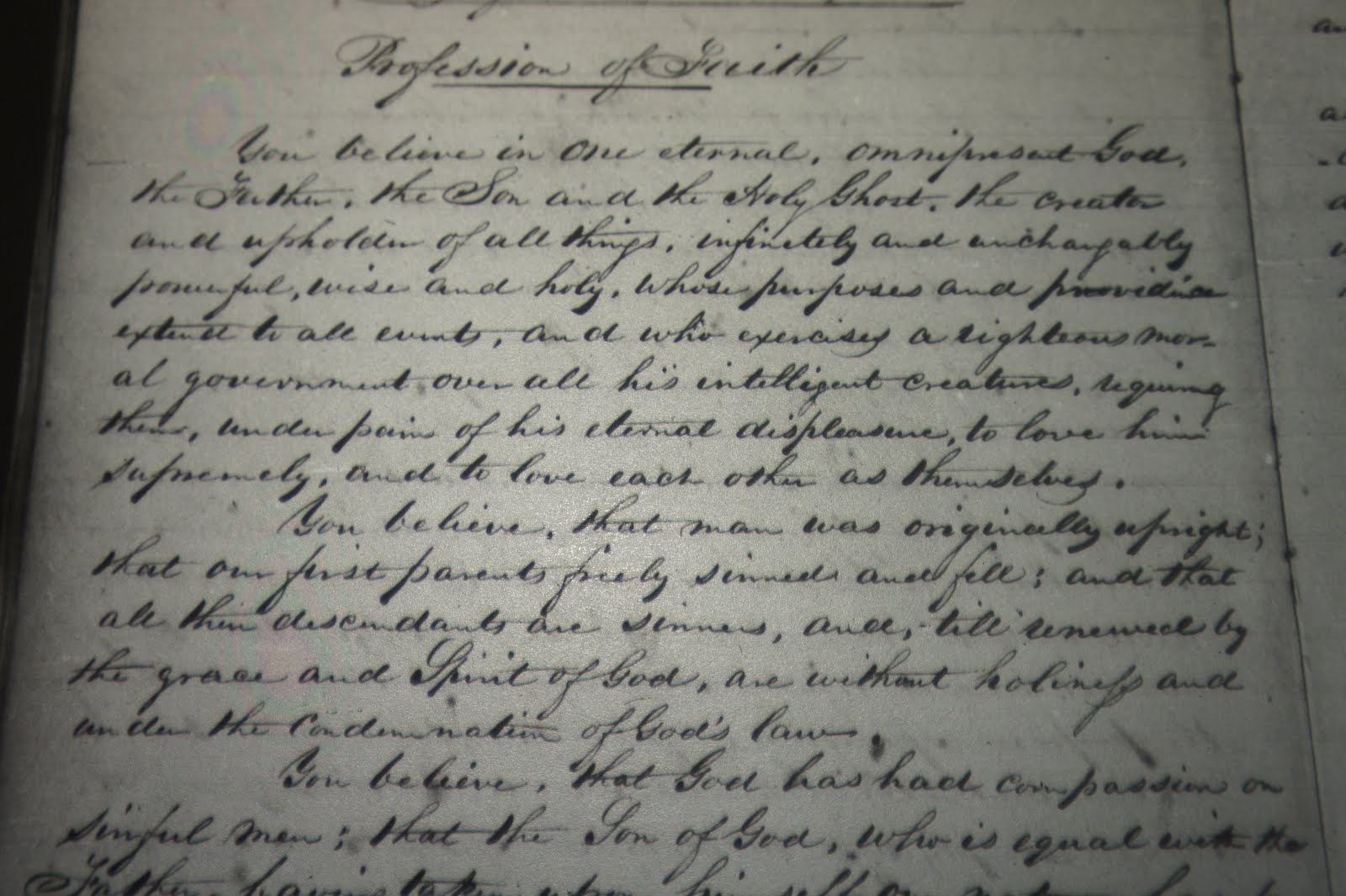
Congregational Profession of Faith
Forming a new Congregational Congregation was an involved process. The occasion for forming a new Congregation arose from two reasons. The first was the result of the rapid expansion in New England. With each new land grant a new community arose. The first item of business, in a new community, was the registration of its "Land Grant Charter" which provided the legal status necessary for the distribution of land. Once established as a legal entity the next item of business was to obtain permission from the Congregational Governing Body to establish a Congregational Society. The process was an acknowledgement of the doctrinal concept of authority. Authority to act in God's name was passed down from one who held the authority to one seeking to obtain it. In response to a request, which was sent to the Church leadership, a committee of ministers was assigned the task of guiding the formation of a new congregation. There were several important items to be resolved. The first and often the foremost was the allocation of tithes collected in the form of taxes. Congregations all ready established in nearby areas were not eager to give up a share of their tithing money. The other issues to be considered were the ability of a new town to support a minister and the availability of an ordained minister. With the given that it was essential that everyone attend church, was the new town so located, that traveling to church each Sunday to an existing congregation posed too much of a burden? This later consideration was the second reason for forming new congregations. Using the example of Killingworth the original Killingworth Congregational Congregation was formed in present day Clinton. As the community expanded northward it became a problem for the people living in North Killingworth to make the trip south each Sunday to church. As in many communities there also arose a division of interests. The northern neighbors where primarily farmers, Southern Killingworth was dominated by the sea. This division of interests was also a factor in their desire for their own congregation. Thus Killingworth divided into two congregations the First and Second Societies. The use of the term "Society" was universal in the Congregational world. The word itself is descriptive of the Congregational mindset, the idea that communial life or "society" in any community existed within a religious framework. With the granting of permission to form a new congregation the first order of business was to record a religious charter which set forth a declaration of their faith. Each was essentially a declaration of Congregational concepts. The point was that each person who joined agreed with the principals so stated and made a pledge to live up to those principals. A part of the larger charter was the "Profession of Faith" which played a primary role in the processes of formal acceptance into the congregation. This copy of the "Profession of Faith" comes from Guilford.
Lyman Doud and Fanny Griffin
This record of the family of Lyman Doud and Fanny Griffin is found in the original records from the town of Guilford. Fanny/Edward/James/Samuel

Subscribe to:
Posts (Atom)